


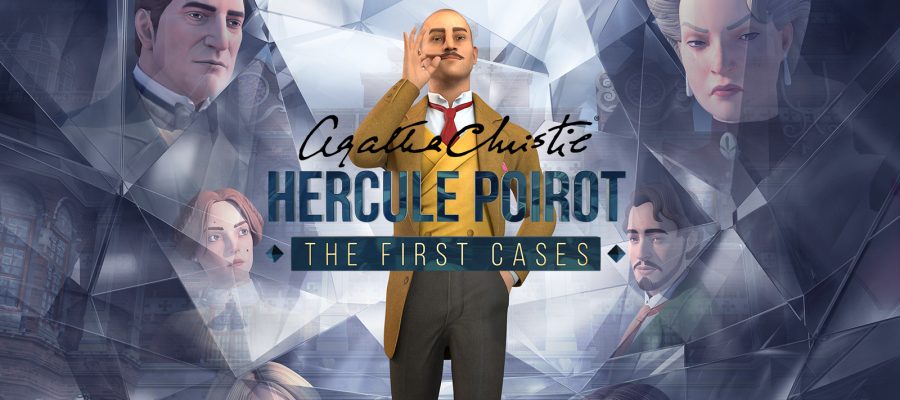
Game: Agatha Christie Hercule Poirot: The First Cases
Genre: Adventure, Puzzle
System: Nintendo Switch (Also on Steam, PS4, & Xbox One)
Developer | Publisher: Blazing Griffin | Microids
Age Rating: US 10+ | EU 7+
Price: US $29.99 | UK £34.99 | EU €39.99
Release Date: September 28th EU | October 5th, 2021 NA
Review code provided with many thanks to Microids
Agatha Christie is a household name when it comes to detective mystery novels, penning 66 novels and 14 short story collections, many revolving around the main character of this game, Hercule Poirot. Hercule Poirot is a policeman turned detective making a name for himself and becoming one of Agatha Christie’s most popular characters. And while I must shamefully admit that I have never dug too deeply into Agatha Christie’s work (although that will change now!), I was very excited to jump into a new mystery game. So without further ado, let’s find out how Agatha Christie Hercule Poirot: The First Cases holds up.
The Origins of Hercule Poirot
Agatha Christie Hercule Poirot: The First Cases (or just The First Cases, as the game will be referenced as in the rest of this review) opens up with a young Hercule Poirot, before his time as a detective. He quickly finds himself caught in the middle of what appears to be a simple burglary, with a young maid asking for his assistance to find the culprit. And with that, the first taste of detective work is hoisted onto the player.

After the initial case, you are taken into the present day, where Hercule is a fresh detective, out to make a name for himself. But don’t think that just because Hercule is a young detective that the cases will be simple to solve. While this game does follow the basis for any mystery novel and you may figure out the answers before the story decides to tell you, there are still some twists that are thrown at you. If nothing else, you’ll find yourself wondering what’s going to happen next.

When it comes to individual cases, there are only a few to chew on, but those few cases are broken into smaller objectives that make it easier to gather evidence. Overall, the amount of time to beat the main objective of the game clocks in at under 10 hours, making this a short and sweet game to pick up.
Explore the Areas of Investigation
There are many locations that you are able to explore in The First Cases. Most of your time investigating will be either interacting with items around you or talking to characters if you need to advance the investigation. While you will have main objectives to solve during your time with The First Cases, these objectives are very vague. Therefore, the game breaks up those large objectives into smaller chunks.
You can view these smaller tasks in what is known as Mind Maps. Any evidence that you find will automatically be sorted in the correct Mind Map, where you can see everything plotted out for you. It’s a great way to take an intimidating case and break down your objectives into bite-sized pieces.

Any items on the map that can be interacted with will show an eye icon overtop of it. Once an item has been investigated, the eye will turn into a gear-like icon, signalling the player that evidence has already been obtained from that item. You don’t have to investigate every item in the game. Truthfully, there’s not much reason for some of the items that you can investigate to be there outside of building ambience, such as windows or plants later in the game.
Link Evidence Together
Once you start gathering enough evidence, you can start connecting clues together to form a hypothesis. Every time that you collect evidence, you will see a notification tied to the relevant Mind Map. Any new evidence has an exclamation mark icon next to it. If you have any evidence that can be linked together, the chain link icon on the left of the screen will display the number of sets you can match. And while some clues are pretty easy to link together, some are not as obvious.
Thankfully, there are no repercussions for linking incorrect clues together. The game also does the additional step of highlighting any clues that were incorrectly linked in red. Handy, whenever you click on a clue. It’s a good way to try to narrow your choices down if you’re going the route of stabbing into the dark.

At some points of the game, you will need to link evidence in order to advance the investigation. Sometimes this can mean new conversations unlocking with specific characters. Or new areas opening up to be investigated or even pressing certain characters for information that they are cautious to offer.

Make Choices
When speaking to other characters, you will often have a list of prompts to select from to make choices. When simply gathering information, you are able to select all of the options one at a time in order to get all the evidence you need. But when you are challenging a character, you will need to be selective about your choices.
In these moments, the character is on guard. Hercule will point out how that particular character has acted around you thus far and will give you a hint as to the type of choices you will want to choose. For instance, if a character has responded positively to your flattery, you don’t want to suddenly be abrasive towards them. If you end up failing to press the character of the information you need. The game will simply reset back to the beginning of the challenge, allowing you another chance.

A More Realistic Approach for the Art
This is not the first Agatha Christie game on the Nintendo Switch. Before The First Cases came The ABC Murders. But the styles between the two games are vastly different when it comes to the character models. The First Cases has taken a more clay-like appearance, with each character almost moulded with precision. However, since the game has taken a step away from a more cartoonish appearance, the imperfections of the models are all the clearer. Up close, the eyes are very haunting to look at, with there almost being a red tinge around the irises. From far away, because you can’t see the immediate details, nothing really stands out too much. Although, a strange thing concerning the art of the game is with the lighting. While there are obvious shadows that can be seen, everything still looks oddly flat in some places.

A very interesting note is that the game is fully voice acted. Not just in English, but French and German as well. My span of gaming is very small, so I must admit having the ability to hear the audio in French and German was not one that I was expecting, but that I found fit the mood very nicely. All of the voice options were done well and I would recommend playing around with the different options.

Conclusion
The collection of mystery games available on the Switch is slowly rising as the years pass. It can be very hard to find a good mystery game. A good mystery needs to hook you in. Keeps you guessing while also encouraging you to press on, and satisfy you with its ending as everything is tied together.
While there can still be a few lingering questions, the major ones had better be answered. And if you are going the route of incorporating gameplay, it needs to be interactive and engaging enough. With The First Cases, this is a mystery game done very well. The storytelling is tight, doesn’t overstay its welcome, and has a nice mix of twists while also keeping everything believable.
Final Verdict: I like It a Lot 
Does this game have one mystery to solve or are there endless mysteries to solve?