

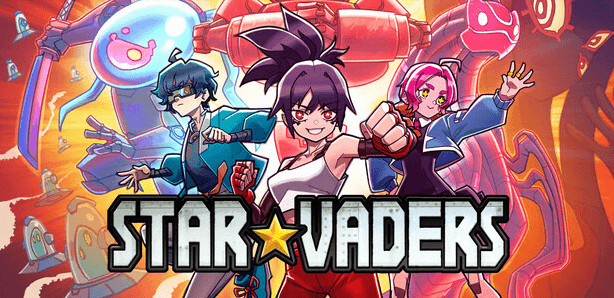
Game: StarVaders
Genre: Indie, Adventure, Strategy
System: Steam (Windows)
Developer|Publisher: Pengonauts | Joystick Ventures, Playworks
Controller Support: yes
Steam Deck: verified
Price: US $24.99 | UK £20.99 | EU € 24,99
Release Date: April 30th, 2025
Review code provided with many thanks to Thinky Games
StarVaders – A Tactical Surprise in Space
Tactical, grid-based games mixed with deckbuilding aren’t usually my strongest genre combination, yet StarVaders clicked far quicker than expected. It takes familiar ideas and blends them into something that feels approachable, flexible, and consistently rewarding to play.
At its heart, StarVaders is a deck-building roguelike where you pilot a mech defending humanity from an alien invasion. That premise alone sold me, but the game wisely avoids burying you in heavy lore upfront. Instead, it puts the focus squarely on learning the systems, experimenting with cards, and enjoying the rhythm of satisfying runs. It’s a game that respects your time, whether you’re settling in for an evening session or squeezing in a run on the Steam Deck.

Learning Without Overload
One of the first things I appreciated was how the game handles onboarding. You’re given a choice between a more detailed tutorial or a lighter introduction that lets you learn through play. That option alone says a lot about the game’s design philosophy. It wants to teach you, not lecture you. But if you want to know more, the game features a compendium to learn about the enemies, world and many more features.
I opted for the full tutorial and found it clear without feeling heavy-handed. Mechanics are introduced in sensible steps, and nothing feels rushed. If you’re already familiar with deckbuilders or tactics games, the streamlined option is there, but for newcomers, the more guided route does an excellent job of easing you in.
The Grid and the Cards
Combat takes place on a grid where your mech begins near the bottom, while enemies advance downward from above. Let too many of them reach your side of the grid, and a “doom” meter fills up, ending the run. It’s a clean system that creates constant tension without overwhelming pressure.
Your actions are driven by cards drawn from your deck. Early on, these are straightforward: movement and basic attacks. From there, things steadily expand. Cards begin to interact in more interesting ways, allowing diagonal shots, movement-and-attack combinations, bombs, and area effects. The joy comes from discovering how these pieces fit together and experimenting with timing and placement.
Each turn becomes a small tactical puzzle. Do you reposition to avoid future threats, or push forward and thin out enemies now? Do you spend resources aggressively, or hold back and prepare for the next wave? These decisions are where StarVaders really sticks out as a game that has you coming back over and over.

Runs That Feel Fair
One thing that stood out to me is how fair the early runs feel. Many roguelikes can knock you out quickly before you’ve had time to understand what went wrong. StarVaders gives you room to breathe. I found myself progressing through multiple stages on my first few attempts, which made learning the systems feel rewarding rather than punishing.
As runs continue, the game introduces tougher enemies and more complex situations, but it does so appropriately. You’re also given choices about which path to take next, with previews of enemy types and encounters. This encourages planning without demanding encyclopedic knowledge of the game.
Building a Deck That Feels Yours
Deckbuilding is at the core of StarVaders, and it’s handled with a satisfying sense of discovery. After battles, you’re offered new cards to add, slowly shaping your playstyle. What starts as a modest deck grows into something far more expressive, especially once you unlock new pilots and mechs.
Each pilot has its own identity, and your deck behaves. This creates a lot of room for experimentation, and no two runs feel quite the same (the roguelike way). One of my favourite parts of playing was simply seeing a new card, trying it out, and watching how it changed my approach. As well as pilots, there are many campaigns to unlock, making this a very content-rich package.
The game also includes a clever rewind mechanic, letting you undo a mistake or retry a turn. It’s a thoughtful addition that reduces frustration while still asking you to think before you mech.

Presentation and Performance
Visually, StarVaders leans into a clean, hand-drawn sci-fi style that feels upbeat and readable. It’s not overly flashy, but it communicates information clearly, which is crucial for a tactics game. Sound effects do their job well, and the music is bouncy and jolly, supporting the action without distraction.
Performance on the Steam Deck is excellent. Controls translate well to handheld play, text remains readable, and it’s easy to lose track of time while playing in short bursts. This is very much a “one more run” kind of game.

Conclusion: Get Your Mech On
StarVaders is another great example of indie developers finding new ways to combine familiar genres. By blending grid-based tactics with deckbuilding and wrapping it in a roguelike structure, it creates an experience that’s easy to pick up but full of depth for those who stick with it.
If you enjoy thoughtful strategy, experimenting with builds, and games that respect both your time and your curiosity, StarVaders is well worth checking out. It may not be driven by heavy narrative, but its systems will have you coming back to the stars and back. StarVaders is quite simply out of this world great.
Final verdict: Two Thumbs Up

Do you like our content?
Subscribe to our daily news and never miss a review!