

Game: Mystic Vale
Genre: Board Game, Multiplayer, Strategy
System: Nintendo Switch (also on Windows, Mac, IOS, and Android)
Developers|Publishers: Nomad Games
Price: US $21.99| AU $ 25.51|CA $ 26.18|€ 17.00 |£15.29
Age Rating: US E|EU 3+
Release Date: 12th March 2020
Review code used with many thanks to Nomad Games
First, a disclosure: I am a dedicated tabletop player. On an average weekend I probably clock 4-6 hours playing the deck-builder Legendary with my friends. I spend enough time on it for it to be a part-time job! So this is the brain I’m approaching this review with, one already deep down the deck-building rabbit hole.
So what is it?
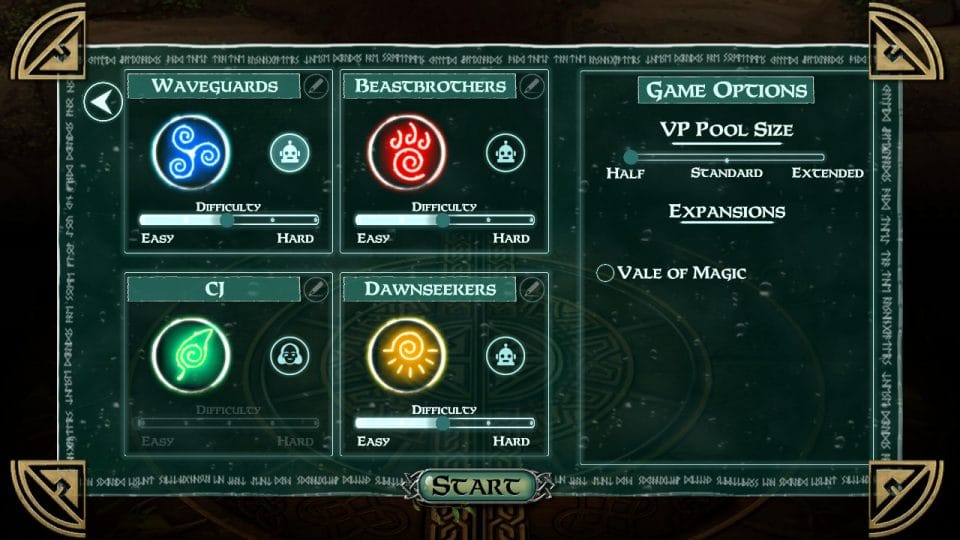
Choose one of 4 groups to play. You can also set difficulty, victory points, and include expansions.
Mystic Vale is based on the deck-building card game of the same title created by John D. Clair. You are part of a group of druids that are trying to restore nature. Like all deck-builders you start with a group of relatively weak cards and use them to purchase better cards, trying to beat your opponents by acquiring the lion’s share of a preset group of points. You can change how many points are played for to adjust the game length.
Gameplay
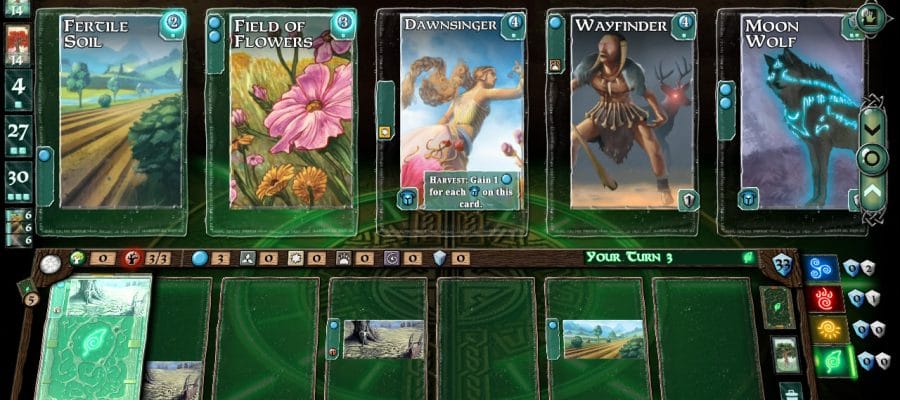
In keeping with the nature theme, you have 3 phases: The planting phase, the harvest phase, and the more traditionally named discard phase. The starting cards have decay tokens and blue mana tokens. Cards are drawn until your gameplay space (or “field”) has reached 3 decay tokens. This includes the card face up on your draw pile (known as the “on-deck” card), which counts toward decay, but not mana.
The planting phase allows you to push your luck and put the on-deck card into your field and reveal your new on-deck card. This allows you to possibly put more cards in play, but could cause you to spoil. Spoiling is when you reveal more than 3 decay tokens at a time. If you do you have to discard your field. When complete, you move on to the harvest phase.
The harvest phase allows you to purchase one of two types of cards: advancement cards (purchased with the blue tokens) or vale cards (purchased with spirit symbols). Both card types offer a variety of advantages that depend on card text, but vale cards can only be purchased after you acquire spirit currency via purchasing regular advancement cards.
Vale cards get played to a section below your field. They also have a variety of benefits based on card text. They appear to stay in play through the remainder of the game, unless you choose to discard one to use a stated ability.
How easy is it to pick up?

Handy learn-to-plays are provided, as well as a quick reference guide
I watched the instructions a couple times before I really got the details sorted. There’s a quick reference guide, and you can preview all the cards in the deck prior to playing. If you have any questions about what a card does, the text accompanying the card preview will likely answer it. It’s often very detailed. Once you get a handle on the basics you’ll likely have no trouble progressing. I’d say overall that it’s pretty easy to pick up.
Graphics?
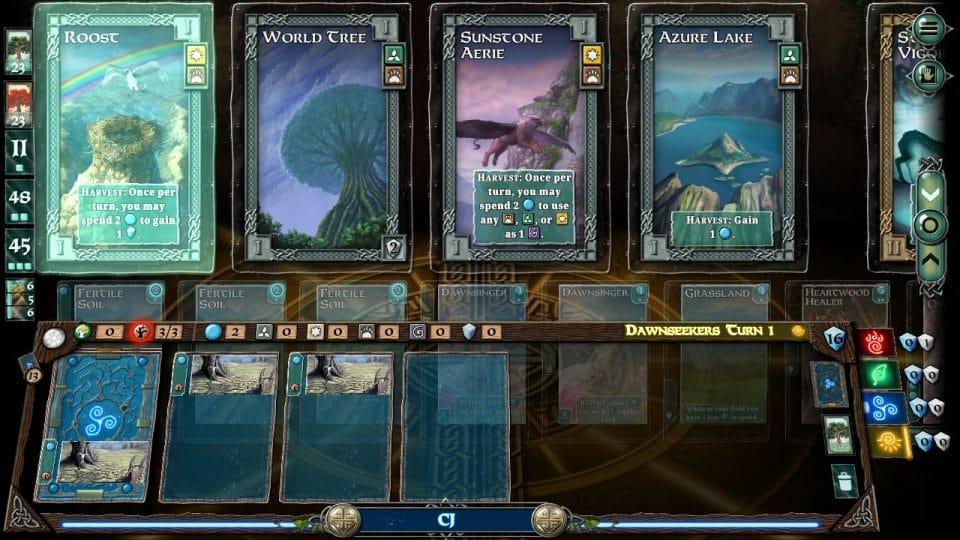
The card designs are beautiful. They feature an assortment of realistically drawn nature scenes, creatures (magical and not), and peoples.
The game graphics are polished, but unfortunately small for this system. For the most part it’s playable, even on the Switch Lite, but I struggled to see the tiny numbers next to the token and spirit symbols. Some of the card text was tough to read as well. Depending on your eyesight, you may find the zoom function to be in frequent use here.
I occasionally lost track of the selector. Not a huge deal since the Switch has a touch screen and tapping would move it where you needed it to be, but I’m not sure how this would play out if you were using the TV. I initially thought this was a glitch, but there’s a couple parts where you seem to be expected to use the touch screen instead of the selector. Frankly, I’m not quite sure whats going on there or how it would play out without a touch screen. That’s the only possible snafu I ran across.
A tip
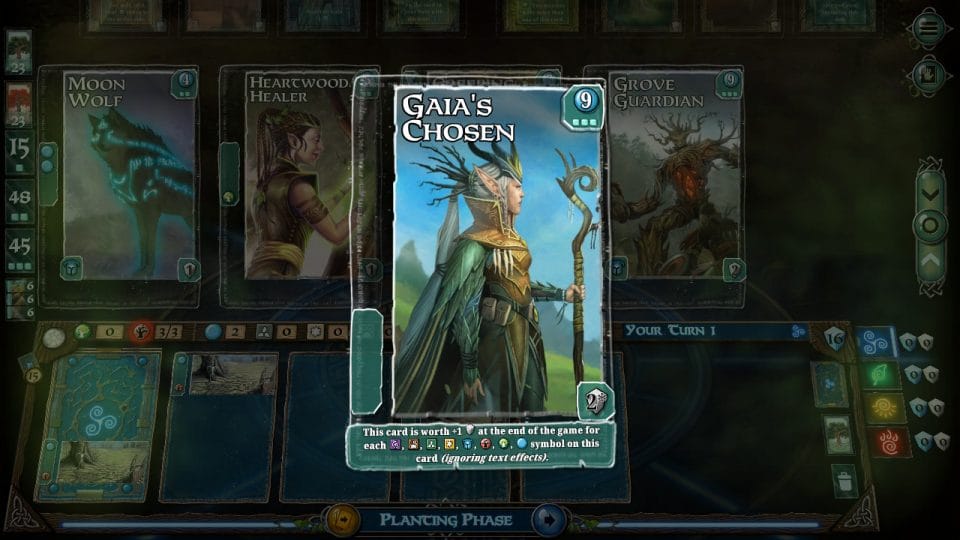
See the tiny text? Now imagine trying to see it if I hadn’t pulled the card forward!
Look at the cards you may be interested in buying before you advance to the harvest phase, as you can’t select a card with the cursor and read the text when in that phase. You can select a card with the touch screen, but I’m unsure how that would work in the TV mode. Eventually you’ll recognize the art and know what the card does, but there doesn’t appear to be a way to examine the text on a specific card once you’ve entered the harvest phase.
What sets this game apart?
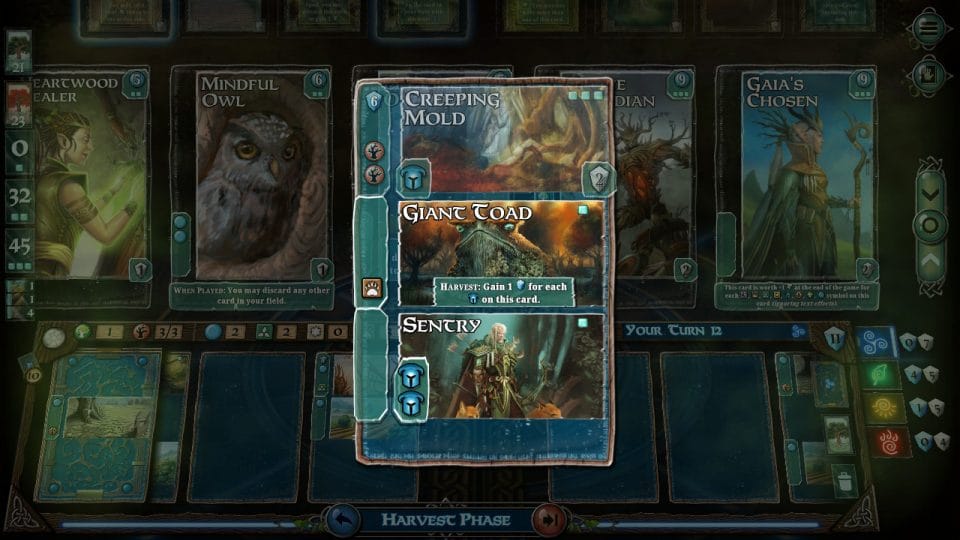
This card is made up of 3 advancements. The VP value of this card is very high.
The card building element! Instead of adding more powerful cards to your deck and then trying to eliminate the less useful cards as you go along, Mystic Vale allows you to add to the original cards with advancements, making your deck more powerful as you advance. Each card is divided into thirds, and each advancement can only be added to a particular third of the card.
There’s a lot of strategy in deciding how to build on to the cards in your deck. In addition to adding buying power through tokens or spirit symbols, certain advancements can eliminate the effects of decay tokens, allow you to avoid discarding if you spoil, or choose another card already drawn to discard, among other things.
The card crafting dynamic is endlessly interesting to me, and the best part of playing the digital version is that you don’t have to disassemble the cards at the end of the game! This eliminates a lot of tedious clean up.
Conclusion
I clearly have a predisposition towards deck-builders. The strategy involved is fascinating to me. This one is no different in that respect. In fact, I can honestly say I’ve become quite addicted, and am really looking forward to the release date so that I can investigate purchasing the available expansions and try the online play!
Final Verdict: I like it a Lot
