

Code provided thanks to Cosmocover’s Digital.
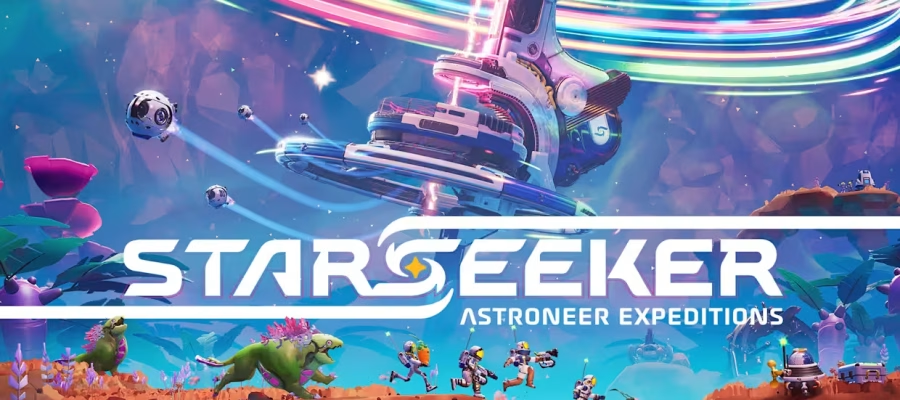
STARSEEKER: Astroneer Expeditions – A New Direction For the Series
I’ll admit straight away that I never spent a huge amount of time with the original Astroneer. I always admired its colourful art style and relaxed atmosphere from afar, but I hadn’t gotten round to playing it. That actually made STARSEEKER: Astroneer Expeditions quite an interesting experience for me, because rather than feeling like a direct sequel, this feels more like a spin-off that takes the Astroneer universe in a different direction.
While the cosy charm is still very much present, STARSEEKER shifts its focus heavily towards multiplayer cooperation, shared objectives, and large-scale expeditions. After spending some time with the Nintendo Switch 2 version, I came away feeling both impressed and frustrated in equal measure. There is a lot of potential here, but it’s also very clear that this is a game still finding its footing.
Welcome Aboard the ESS Starseeker
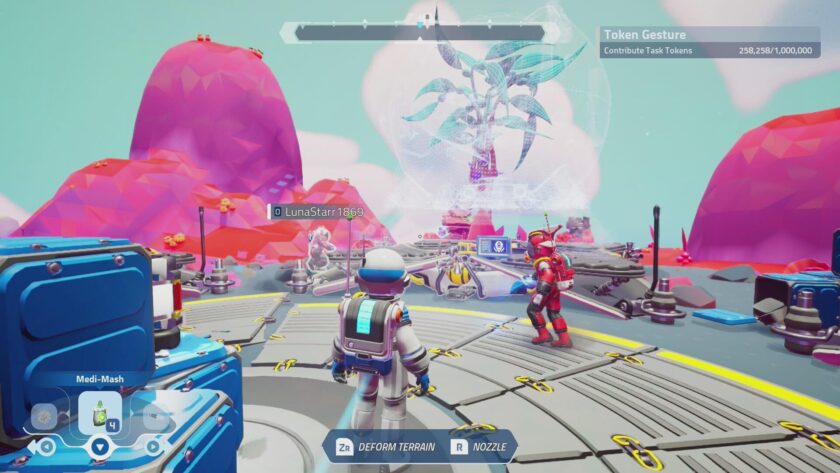
You play as a cheerful little astronaut aboard the ESS Starseeker, a massive space station filled with other players preparing for expeditions across mysterious alien worlds. Your goal is to venture down to planets, complete objectives, gather resources, and return safely before your expedition timer expires. Most missions involve activities such as scanning wildlife, analysing plant life, collecting resources, or completing various exploration tasks. Each deployment gives you a limited amount of time before you’re expected to return to the station and cash in your rewards. Those rewards can then be used to unlock new equipment, improve your loadout, and naturally, purchase a few cosmetic goodies along the way. It’s a simple loop, but one that has a lot of room to grow.
A Tutorial That Leaves You Adrift
One of my biggest issues during my time with the game was the onboarding process. Now, technically there is a tutorial. It introduces the controls reasonably well and gets you moving around the world without too much trouble. The problem is that it doesn’t do a particularly good job of explaining how everything fits together once you’re actually let loose. I frequently found myself thinking, “Right, I understand what button does what… but what exactly should I be doing now?”
The game often felt as if it assumed I already had experience with this style of Astroneer gameplay. Objectives existed, but understanding how to efficiently complete them wasn’t always obvious. Occasionally the game would even tell me I was doing something wrong without offering much guidance on how to fix it, which became a little frustrating. Given enough time, I managed to figure things out through experimentation, but I do think newer players may find the opening hours somewhat overwhelming.
Co-op Done Surprisingly Well
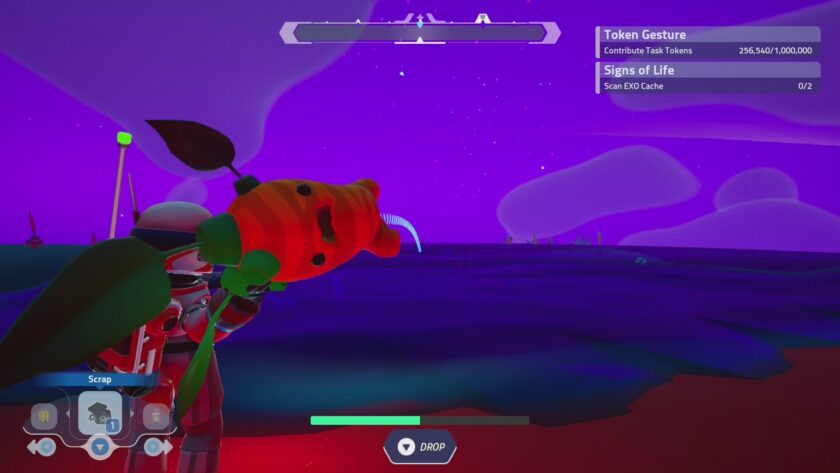
If there’s one area where STARSEEKER genuinely impressed me, it’s how it handles multiplayer. The game is built around cooperation, but thankfully not in a way that forces players into constant communication. The central station acts as a shared social hub where players wander around preparing for missions. You can attempt to form squads, invite others along, or simply head out by yourself. In my case, most of my attempts at gathering a team weren’t exactly successful. Whether that’s because everyone was busy or because nobody wanted to follow an ageing astronaut into danger remains open for debate. That didn’t stop me from enjoying myself.
Once planetside, other players are naturally spread throughout the world pursuing their own objectives. The result is a relaxed multiplayer experience. You aren’t competing for resources, nobody is hampering your progress, and there never feels like there’s pressure to keep up with everyone else. I particularly liked the ping system. It’s simple, useful, and allows players to communicate objectives without needing voice chat or lengthy messages. For a game built around cooperative exploration, STARSEEKER creates a friendly atmosphere.
Exploring Is The Real Highlight
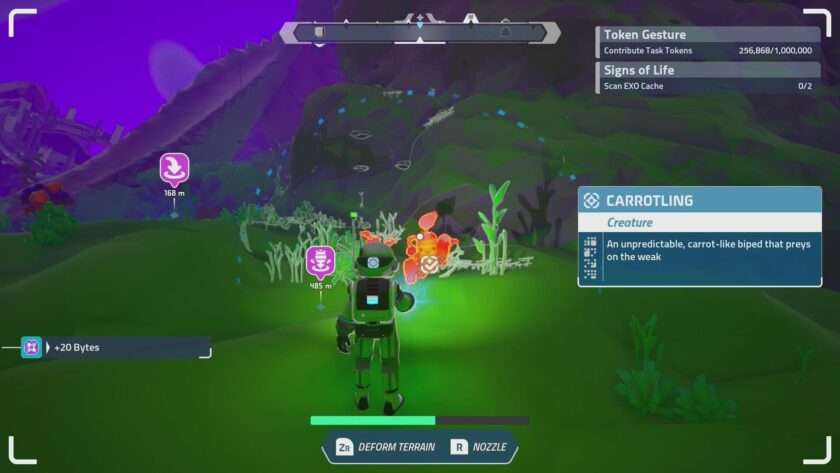
Despite my issues with direction and tutorials, I found myself genuinely enjoying the act of exploration. The planets are beautiful. The art style retains that signature Astroneer look with soft colours, rounded shapes and a wonderfully tactile appearance. Everything looks as though it has been sculpted from colourful modelling clay. I absolutely loved wandering around simply taking in the scenery. Then there’s the scanning. Anyone who has followed my reviews for a while will know I have a soft spot for games that let me catalogue wildlife and scan absolutely everything in sight. STARSEEKER fully embraces that obsession. Plants? Scan them. Animals? Scan them. Scrap metal? Scan it. Mysterious objects? Definitely scan them. The process itself is wonderfully simple. Point your scanner at something, wait for the progress bar to fill, and you’re done. There were moments where I completely forgot about my objectives because I was too busy documenting every strange creature and object I stumbled across. Don’t forget you are on the clock in missions.
Some Rough Edges Still Need Attention
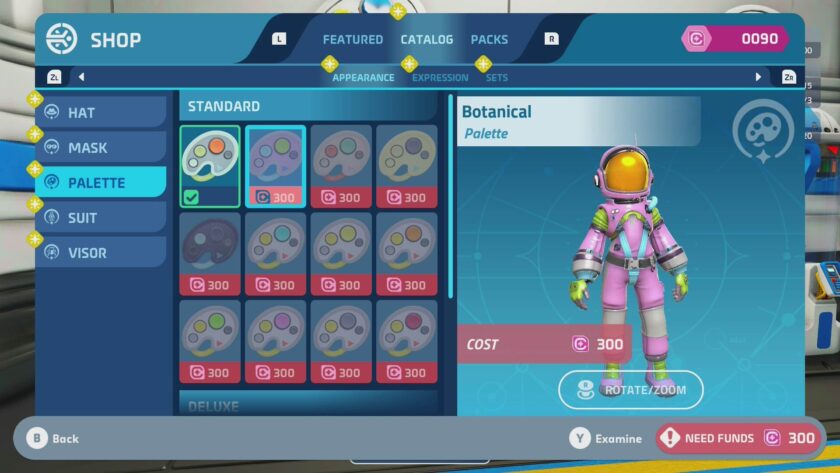
Unfortunately, the game’s early access status becomes impossible to ignore in places. Performance and stability were inconsistent during my play sessions. The biggest issue wasn’t traditional crashing, but rather being disconnected from servers entirely. Because STARSEEKER is an online-only experience, these disconnects can be particularly frustrating. Even while playing solo, losing connection means being removed from your session. I also wasn’t entirely sold on the presence of premium cosmetic purchases this early in development. That’s more of a personal observation than a major criticism, but it did feel slightly odd seeing monetisation options while many of the game’s core systems still feel unfinished.
Final Thoughts
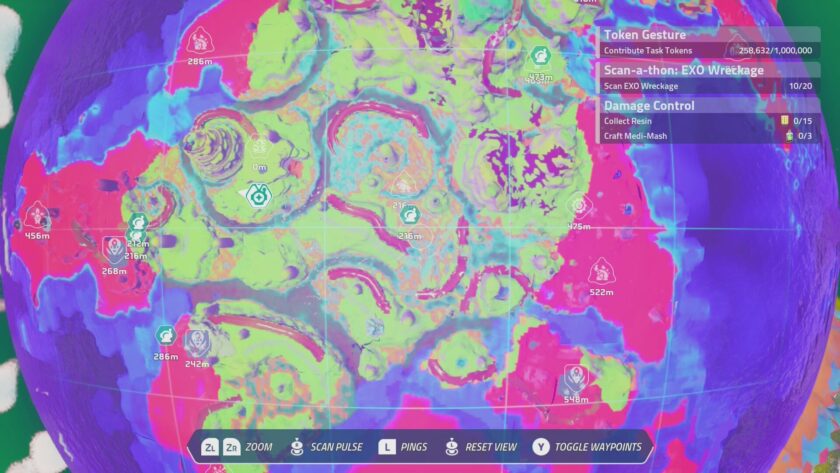
STARSEEKER: Astroneer Expeditions is one of those games where I can clearly see the destination, even if the journey isn’t quite there yet. The foundations are genuinely strong. The cooperative design is welcoming, the planets are lovely to explore, and the scanning system absolutely hooked me. Most importantly, it captures a wonderfully relaxed atmosphere that encourages players to move at their own pace rather than constantly rushing from objective to objective.
At the same time, the game needs clearer guidance, better onboarding, and improved stability if it wants to win over players who aren’t already familiar with the Astroneer universe. I never felt like I was playing a bad game. Quite the opposite, actually. I felt like I was playing a game with a great deal of potential that simply hasn’t reached its final form yet. If the developers can smooth out the rougher edges during early access, STARSEEKER could become something quite special. For now, though, it feels very much like a work in progress, an enjoyable one, certainly, but a work in progress nonetheless.
Do you like our content?
Support LadiesGamers as a member on Patreon!
 Or buy us a cup of coffee or tea on Ko-Fi!
