

Game: Trash Goblin
Genre: Adventure, Puzzle
System: Steam (Windows)
Developer | Publisher: Spilt Milk Studios Ltd
Controller Support: Yes
Steam Deck: Unknown
Price: US $ 19.99 | UK £ 16.75 | EU € 19,50
Release Date: May 28th, 2025
A review code was provided, and many thanks to Plan of Attack.
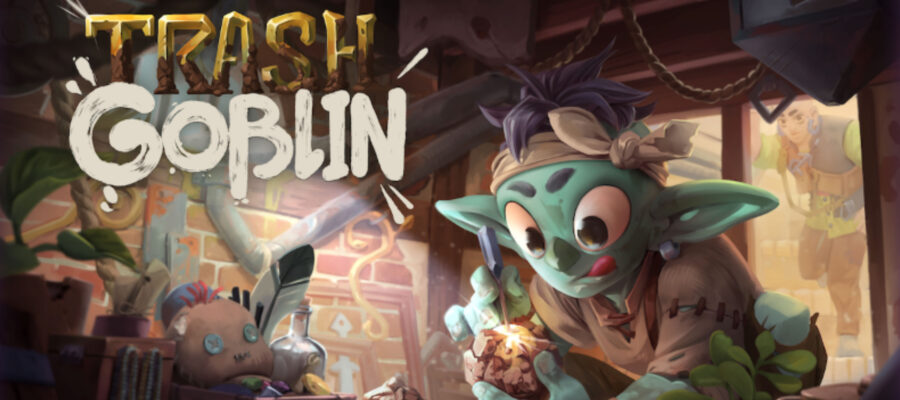
Trash Goblin is a 2025 puzzle game developed and released by Spilt Milk Studios Ltd. It was released last year in Early Access, and you can read my impressions here if you’re curious.
The Premise Trash Goblin
In Trash Goblin, we play as a young goblin who runs their shop, where they repair and clean trinkets and sell them to an endless stream of colorful and quirky customers. We earn money that we can use to upgrade our shop, our tools, and our personal space.
Gameplay
The main objective of Trash Goblin is to clean and repair trinkets and sell them to customers. We start with three basic tools on our workbench: a sponge and chisel for cleaning and pliers for repairing. As we progress in the game and earn more coins, we can purchase new helpful tools and upgrade our set-up.
We have several areas. Besides the workbench where we clean and repair trinkets, we also have a customer desk where we interact with customers, the “stairs” where we can buy and upgrade tools, and our bunk bed in the personal space. We have a limited amount of activity slots in a day – 6 in total, after which our goblin needs to sleep for the new day to start. Saving is automatic and happens at the end of the day.
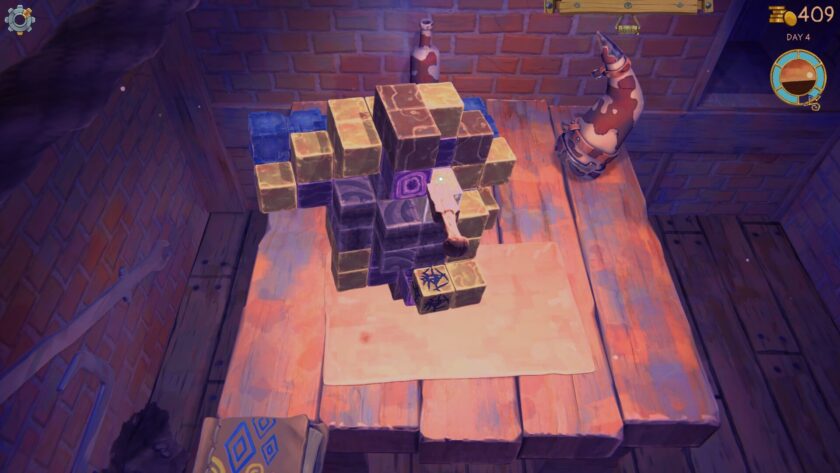
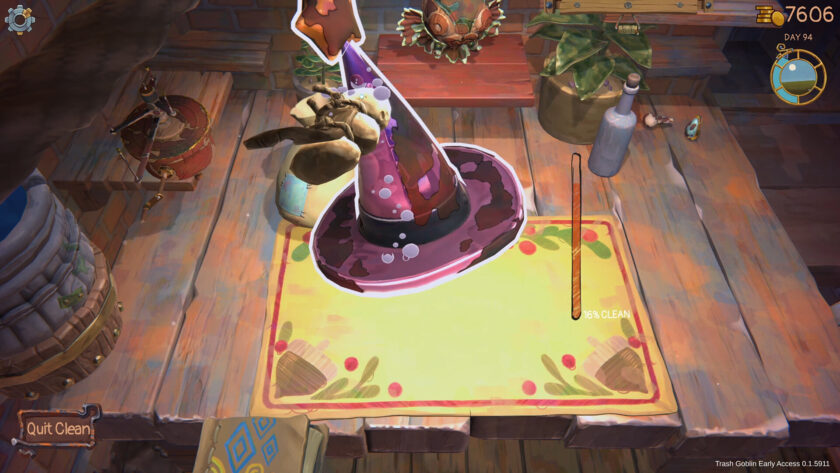
We work on our trinkets on the workbench. The trinkets come in bags, and after opening them, we are greeted by a puzzle involving clearing blocks away. Some of the blocks fall away easily, while others require more mouse clicking. Some of the blocks, once clicked, have markings on them, meaning that they are parts of the trinket itself. Once all the rubble is cleared, we have a dirty trinket. Since removing the blocks takes a whole activity slot and cleaning is another slot, it’s wiser to store the trinkets without cleaning them. Some customers don’t need clean trinkets anyway.
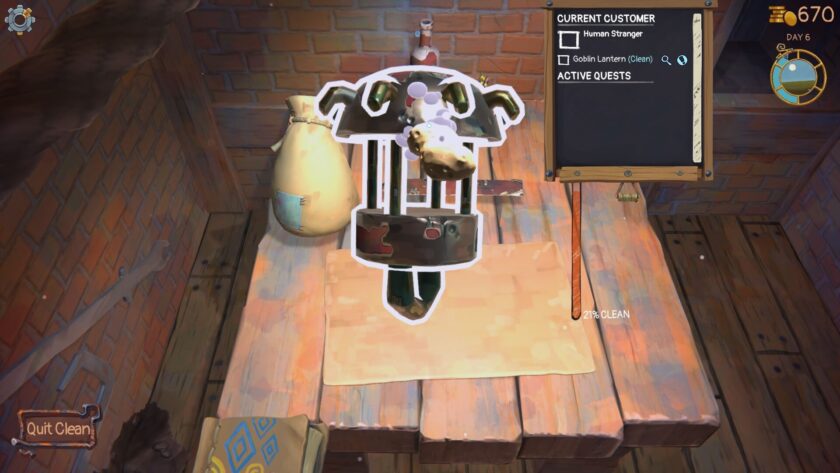
Most of the trinkets are parts of something else – like the hilt of a dagger, the lid of a beer stein, and so on. Sometimes, parts are precisely what our customers are looking for; other times, we’ll have to present them with the whole repaired item. Repairing a trinket involves combining several trinkets to create a new item. This could be anything from reuniting a pot with its lid to creating a lyre with a natural charm attached.
We interact with customers at the customer desk. Standing there and waiting makes no sense, as once a customer is waiting, we hear a little bell, and the icon for the customer desk at the bottom of the screen features a tiny humanoid figure. Then, we can proceed to the customer desk. Each customer has its mannerisms, character, and quirks. They ask for a specific trinket, and if you have it, you place it on the customer desk in front of them. If not, you can look for it in the following few bags.
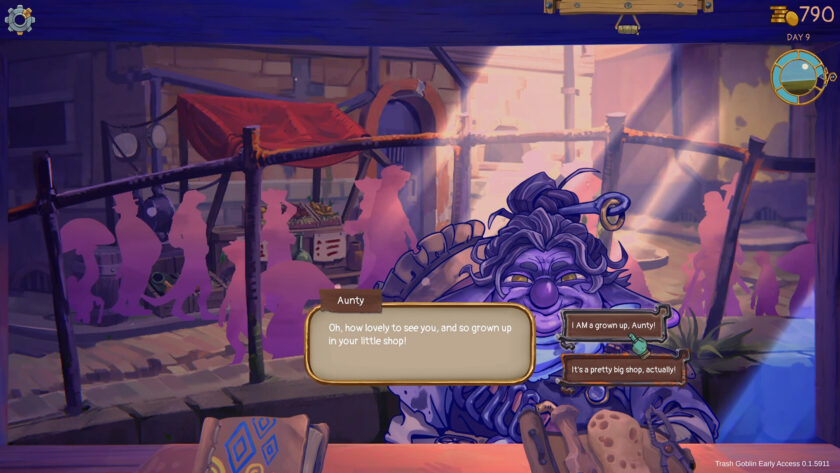
We can also dismiss customers. Unnamed customers leave and don’t return. Dismissing named customers is a new feature of the full game. If you dismiss a named character, they can be called back at any point, anywhere, once we have the item they are looking for. One notable improvement over Early Access is that the chances of finding what they are looking for quickly are significantly enhanced. I’ve tested it with several trinkets, and within a few bags, no more than three, the wished-for item appears. We also have a handy board on top of the screen where we list the trinket orders, including the state they should be in.
Once we are ready with the order, we place the item in front of the customer. If you’ve found what they are looking for, they will buy it, offering you a bag of coins. It’s essential to place the bag in your inventory. We have inventory on the left-hand side of the screen, but the space is minimal, so storing items on the workbench makes a lot of sense. In later stages of the game, when the store is open, you can purchase extra shelving for the workbench. One new feature in the full version of Trash Goblin is the addition of Trinketpedia, accessible in a tab within the inventory. This addition tracks every single trinket in the game and keeps a record of whether you’ve discovered, cleaned, upcycled, and sold each one. At a later stage, there’s also an option to purchase some trinkets you are looking for.
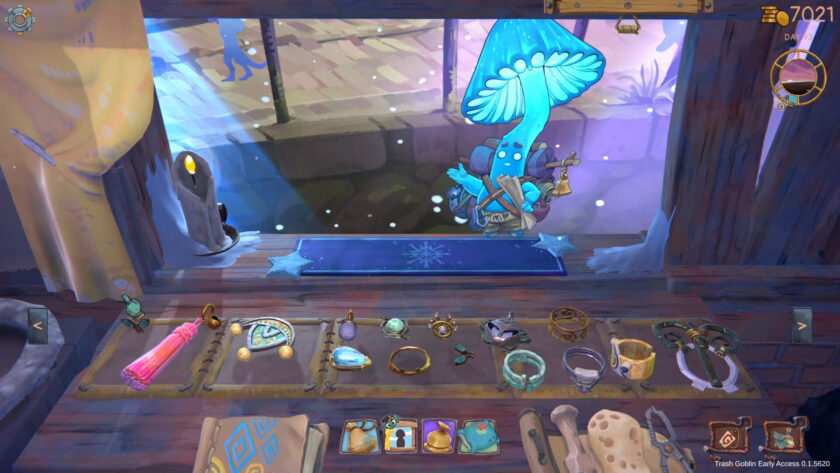
Besides the marked performance improvements of the full game compared to the early access, Trash Goblin also features a storyline, newly named characters, each with their related quests and trinkets, and over 100 new trinkets, which is more than double the number of trinkets in the Early Access game. Additionally, a new feature is District Travel, which enables us to explore two new areas of the city where we can sell trinkets in pop-up shops.
Some Other Things
Trash Goblin now has Steam achievements but no trading cards. The game features basic audio and video settings and an automatic save system. It is not officially Steam Deck playable, but players have reported that it runs smoothly.
One negative of the Full version is that progress from the Early Access is not carried over. That being said, the developers are keeping an Early access copy of the game and have written a guide on how to access it.
Conclusion
I liked Trash Goblin in its Early Access version. There were some things to iron out, but it had a lot of promise and potential. I am happy to report that the full version more than lives up to that potential. Trash Goblin is a delightfully relaxing and cozy puzzle game; if you enjoy the genre, I recommend trying it – you’ll love it.
Final Verdict: Two Thumbs Up: 
Do you like our content?
Support LadiesGamers as a member on Patreon!
 Or buy us a cup of coffee or tea on Ko-Fi!
