


Code provided thanks to Twig Stick Studio.
Orb Guard – Out of World Experience
It’s funny how many new genres have appeared over the years. Back in the day it felt like everything could be neatly placed into a handful of categories. Platformers were platformers, action games were action games, and strategy games were strategy games. These days we’ve got roguelites, survivor-likes, soulslikes, auto battlers, extraction shooters and countless hybrids in between.
Orb Guard falls into that modern category of games that mixes several ideas together, but thankfully it does so in a way that’s easy to understand. After spending some time with the demo, I came away with a pretty positive first impression. I wasn’t particularly good at it, mind you. Earth probably questioned my ability to protect it on several occasions. Still, I had a lot of fun trying.
Defending Earth
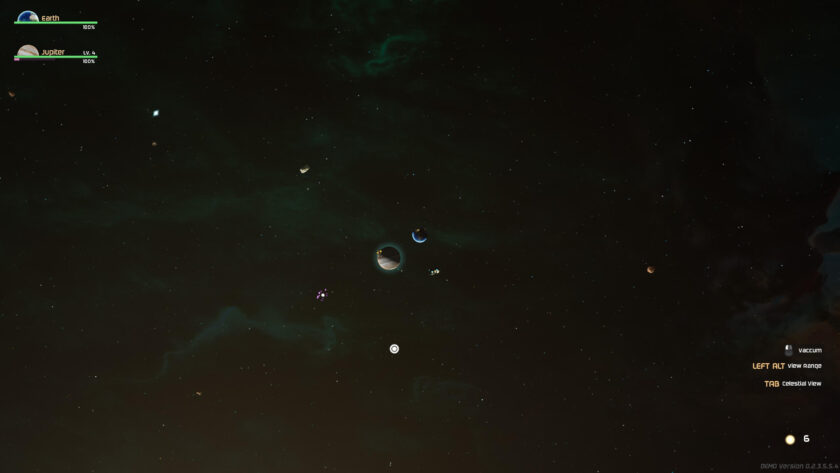
Earth is under attack from all manner of cosmic nasties. Asteroids, alien threats, strange space debris and other hostile objects are all making a beeline for our poor little blue planet. Your job is to stop them. Rather than directly controlling a ship or firing weapons yourself, you deploy and manage planets (or Celestial bodies) that orbit around Earth. These act as your defensive line against the incoming threats.
The demo offers a small selection of starting Celestials, including the Moon, Neptune and Jupiter. Each comes with its own strengths and weaknesses, which immediately gives you different ways to approach a run. The Moon, for example, is quick and agile but doesn’t have much health. Jupiter sits at the opposite end of the spectrum, rotating much more slowly but offering significantly more durability. Even from the demo alone, it feels like there’s room for experimentation depending on how you prefer to play.
Simple Controls
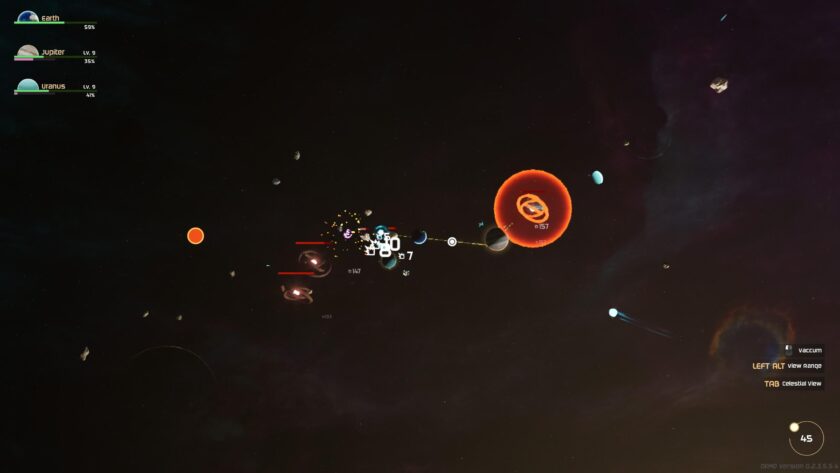
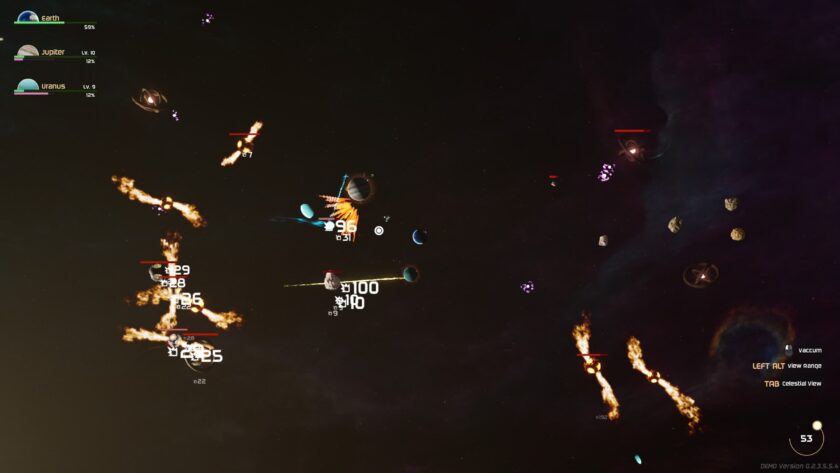
One of the things I appreciated most was how approachable Orb Guard is. The controls are straightforward. You can rotate your Celestials around Earth, positioning them to intercept incoming threats. That’s pretty much the core interaction, and it works well. It strikes a nice balance between being active enough to keep you engaged while avoiding the frantic overload that some survivor-style games can fall into. Though that’s not to say things don’t get a bit cluttered the further you survive into the game.
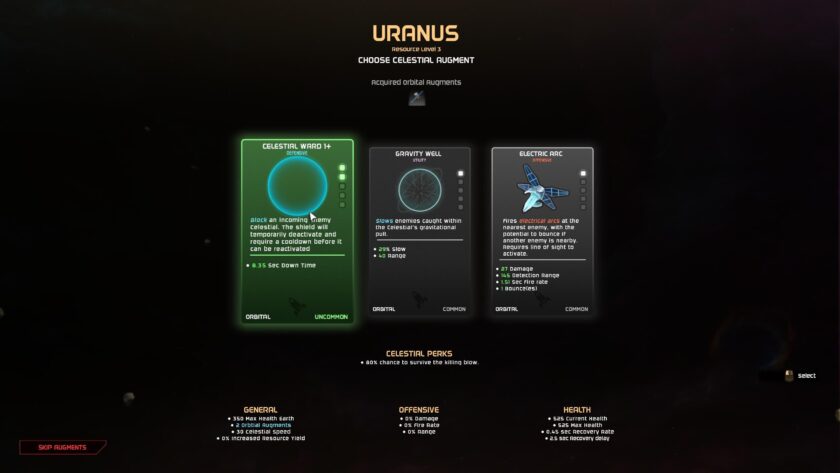
As enemies are destroyed, you gain experience and level up. That’s where the roguelite side of the game starts to shine. Each level grants a choice of upgrades. Some are offensive, some defensive and others provide utility benefits. You might gain small turrets attached to your Celestial. You could unlock protective shields, regenerative bonuses or even support craft that assist in combat. Every run starts to develop its own personality based on the choices you make.
One upgrade that particularly caught my attention involved linking nearby Celestials together with a laser beam that damages enemies caught within it. I loved the concept, although I must admit I struggled to use it effectively. Keeping multiple orbiting bodies positioned correctly while everything else is trying to destroy Earth proved slightly beyond my skill level.
A Strong Foundation for Progression
Like most roguelites, failure isn’t the end. In fact, failure is expected. After a run ends, you earn resources that can be spent on permanent progression. These unlock new Celestials, additional upgrades and other bonuses that make future attempts more rewarding. The demo only scratches the surface here, but the framework already feels solid. The full game promises additional missions, more unlocks, new Celestials, bosses and multiple survival modes, which should add plenty of replay value for players who enjoy chasing upgrades and experimenting with builds. Even within the limited demo, I could see the appeal of gradually unlocking new options and finding combinations that work well together.
Great Space Theme
Visually, Orb Guard keeps things spacey, out of space obviously. The planets are easy to distinguish, the threats are clear to identify, and the overall presentation fits the theme nicely. There aren’t any unnecessary visual distractions getting in the way of gameplay. Space itself is mostly empty, as one expects, but the various asteroids, ships and strange cosmic objects provide enough variety to keep things visually interesting.
The tutorial deserves a quick mention as well. It’s concise, easy to follow and teaches the basics without overwhelming the player with walls of text. More games could learn from that approach.
Final Thoughts
Orb Guard takes several familiar ideas and combines them into something that feels fresh enough to stand out. The concept of defending Earth using orbiting planets is a clever one, and the gameplay loop is immediately easy to grasp.
The demo left me wanting to see more, which is exactly what a demo should do. I certainly wasn’t setting any high scores during my time with it. Earth may have suffered a few unfortunate endings under my watch. However, every defeat made me want to jump back in and try a different approach, and that’s usually a good sign.
Based on this early showing, Orb Guard looks like a promising little roguelite with a fun space-themed twist. If you’re a fan of survivor-likes, auto battlers or simply enjoy games that are easy to pick up and play in short bursts, this is definitely one worth keeping an eye on.
Do you like our content?
Support LadiesGamers as a member on Patreon!
 Or buy us a cup of coffee or tea on Ko-Fi!
