

Game: Worlds Upon The Wind
Genre: Indie, Strategy
System: Steam (Windows, macOS, Linux & SteamOS)
Developer | Publisher: Max Shawabkeh
Controller Support: None
Price: US $8.99 | UK £7.65 | EU € 8,77
Release Date: July 23rd, 2026
Review code provided with many thanks to Max Shawabkeh.
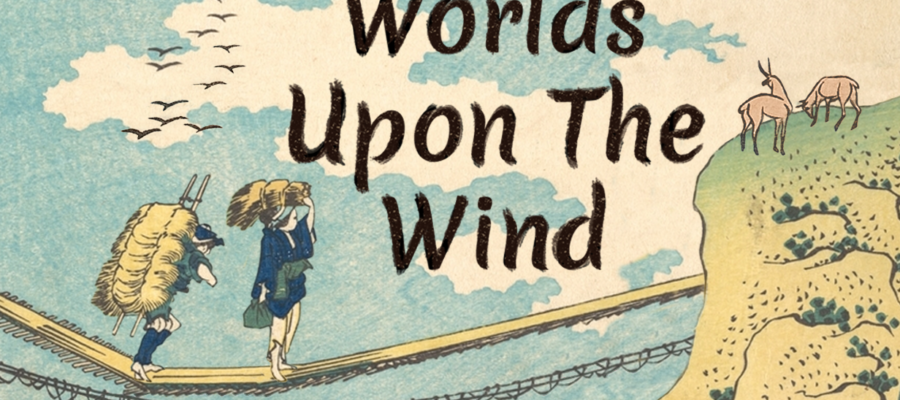
Worlds Upon The Wind is a solo-developer-made deck-builder game with a unique visual style that traces the evolution of Japanese art. Your focus is to serve as the guide for a broken and scattered civilization.
Helping a Shattered World Become Whole
This is the first time I played a full deck-building game, and it left me wondering why I let that much time pass before I played one. The idea of a peaceful deck-building game inspired by classical Japanese art and helping heal a broken and scattered civilization simply fascinated me. I was pleasantly surprised by how the game developer, Max Shawabkeh, brought this concept together.
Worlds Upon The Wind starts right away with a cutscene telling the story of how the world barely survived “The Shattering”, numerous natural disasters that scattered the entire civilization across 10 thousand world shards adrift upon the wind. The story is told just as an elder would, passing down the history of humankind to the next generation through old scrolls full of ancient paintings.
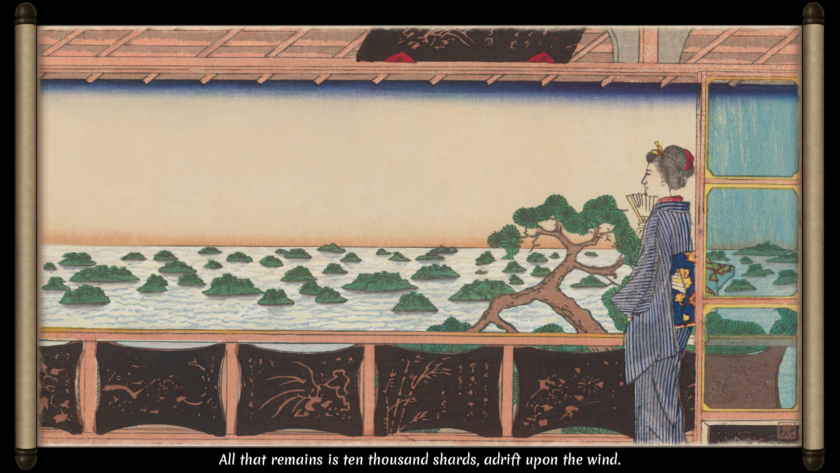
The player is treated as a deity, being called the “Enlighted One” by the game characters. The first main character you encounter, the Scribe, follows your prophecy to put the shards back together, sending you through expeditions to a different shard in every run.
Gameplay of Worlds Upon The Wind
As for the mechanics, for someone who is new to deck-building games, trying to understand and explain the gameplay of Worlds Upon The Wind is harder than I thought, but I learned so much by playing it. It reminded me of the first time I understood the strategy behind materia in Final Fantasy VII Remake to be able to defeat the Hell House in hard mode. That literally rewired my brain.
Thankfully, the tutorial is simple, easy to follow, and thoroughly explains the different components of the game: Glyphs, Essence, Essence Slots, Inspiration, Developments, and Invocations, to name a few. It walks you through your first task of rebuilding a Torii Gate and through your first expedition to a new shard.
Something I find highly useful is the information cards that appear on screen even after you complete the tutorial. If you hold the Ctrl key, it’ll give extra information for the words that are underlined, in case you ever forget their meaning or what you’re supposed to do with them.
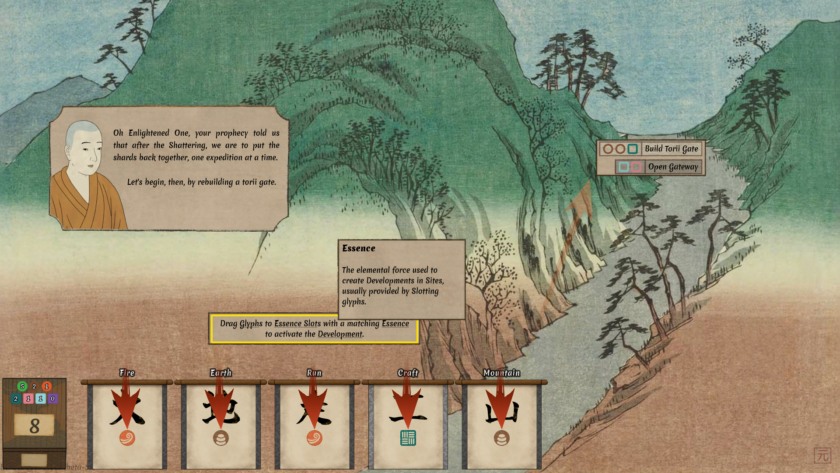
In every run, you’ll go to new shards, ready to be populated. Your turn ends when your inspiration points run out by not completing specific goals, or by cards with negative traits. It is then that you need to return to your home base: The Haven.
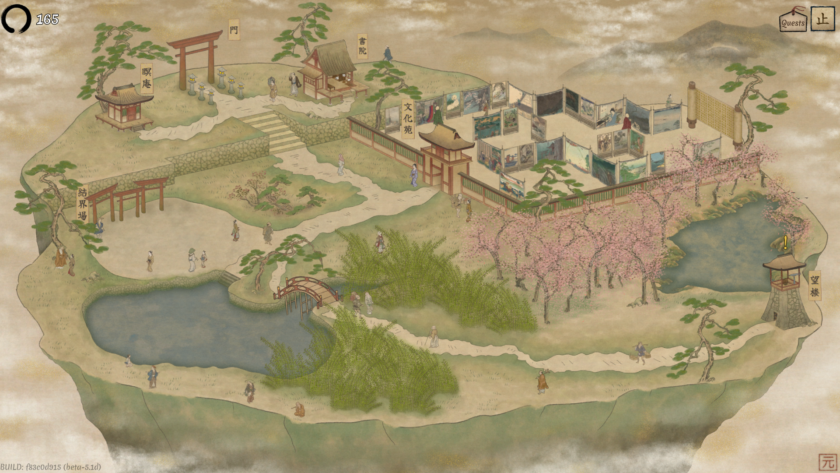
The Haven is where the main characters: Scribe, Historian, Explorer, and various NPCs, such as monks and refugees, live. In this area, you can improve your skill tree; play some minigames to practice your Japanese skills; check out the museum to recall all the things you have discovered; showcase your favorite paintings and even interact with the inhabitants by clicking on them. The Torii Gate will lead you on a new expedition to a new undiscovered shard.
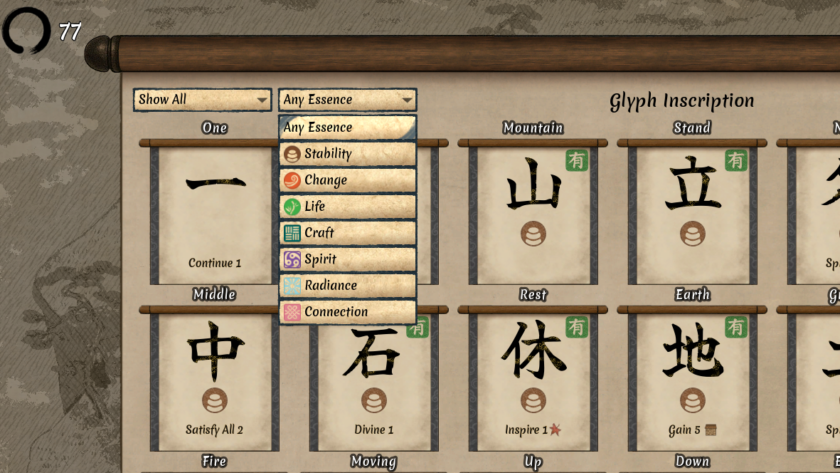
Worlds Upon The Wind introduces glyphs as the cards used to shape the sites of each shard. Each glyph provides a different essence or a combination of them: Stability (brown circle), Change (orange circle), Life (green circle), Craft (Turquoise square), Spirit (purple square), Radiance (light blue square), and Connection (pink square).
To build and create new settlements (Developments) on an inhabited shard, you first need to select the area of your foray on any available spot on the map. It will then give you a couple of site options to choose from, for example, forests, small buildings, swamps, mountains, plains, canyons, and more. Once you decide the development you want to create on each site, you need to drag and slot glyphs to their corresponding essence slot to activate them.
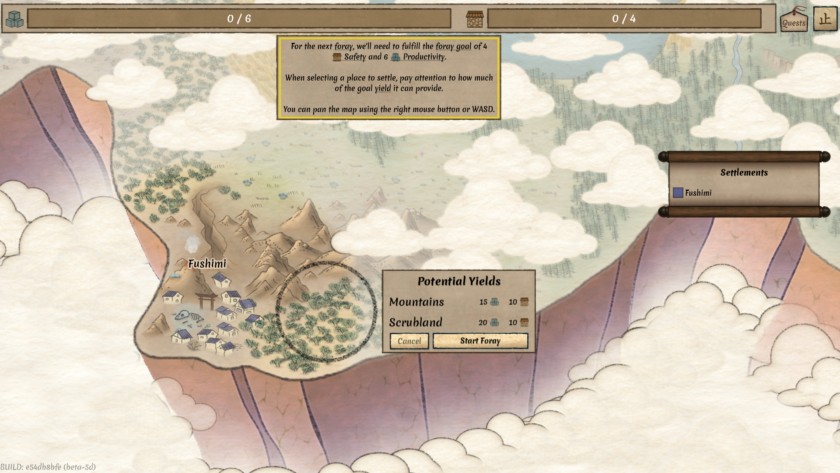
When creating a new foray, you’ll see the potential yields of that piece of land versus the yield goals you need to achieve. In total, there are 7 yields: food, safety, adventure, harmony, beauty, productivity, and knowledge.
When things get tough, there are many glyphs with invocations that provide specific yields or even double yield gains.
It is your job to see which strategy better suits your goals: either use these invocations to achieve them or use the glyph to unlock special events and relics. Beware, some invocations may be beneficial, such as filling 2 essence slots, but it may also discard 2 random glyphs from your hand, so be careful with how you strategize this. I learned this the hard way.
There are also so many interesting items in the game that will make your strategies even more complex, such as relics, animal companions, special events, spirit huntings, surveys across the land, even negative glyphs. That unpredictability is part of the experience. You’ll come to learn that not being able to achieve a perfect goal is part of the journey. As a perfectionist and completionist gamer, I was reminded that life doesn’t always work like that, and that’s okay.
A Love Letter to Japanese Culture
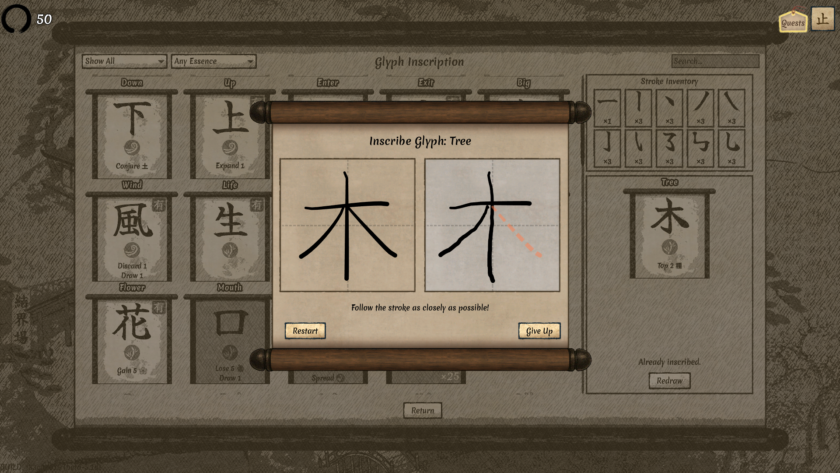
The thing that drew me into playing Worlds Upon The Wind was how beautifully it blends Japanese language into the game. If you’re learning Japanese, just as I am, the game integrates a couple of optional minigames into your gameplay that are extremely valuable for practicing kanji skills.
One of them teaches you how to draw the kanji symbols of all the glyphs you discover throughout your expeditions. Another minigame is matching the kanji symbol to its meaning in English. You can also guide yourself to match the corresponding essence of the glyph and memorize it. You can filter them by grade level and JLPT level. Even by practicing, you earn game points that serve to improve your skill tree. It’s a nice addition to the game.
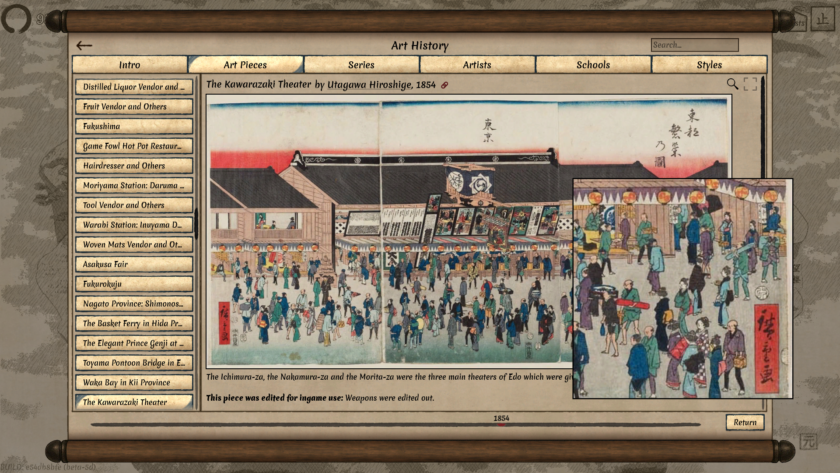
Another favorite thing for me is the Art Viewer. The game also includes historical art and original artwork with the same style. Each painting you encounter has an icon on the bottom right corner that shows the original woodblock print or scroll it uses. When you click on it, the Art Viewer opens. It is a mini wiki that contains historical information about the art, such as authors, historical context, the period when it was made, and if a modification was made for it to be included in the game.
There are 15 animal companions, more than 350 glyphs, 100 relics, and 200 choices to make that will level up your game and give you a true personalized experience in the game. If you’re entirely new to these types of games, like I am, the game might frustrate you when thinking of new strategies to continue with the main quests, feeling like you have hit a wall after many failed attempts. However, even though I felt like this trying to advance with the main story, it just means there is plenty for me to explore and discover in the game.
Worlds Upon The Wind is not meant to be solved quickly and easily; rather, take your time with it, explore new shards every time, get acquainted with the game mechanics, immerse yourself in the Art Viewer, and connect with the story of each one of these settlers in need to rebuild their lost and broken civilization.
Conclusion
For me, video games are a form of art, and Worlds Upon The Wind is literal proof of that. When a game is made with such passion, you can see it in the final product. It feels like a love letter to Japanese culture in so many ways. From its unique art style, showcasing ancient picture scrolls and Japanese woodblock prints, to its gentle, serene music. It is a peaceful blend of deckbuilding, strategy, and relaxing gameplay. The game itself is art, and you feel you’re inside one ancient Japanese original painting from the main menu.
Since I had a couple of questions while playing the game, I joined the Discord. I was followed by quick replies from other gamers and the game dev, and I even got some insights into the game art and how it was created. This is why I love indie games. The closeness you have with developers and the ways they go above and beyond for people to enjoy their games.
Worlds Upon The Wind reminds me to get out of my comfort zone every now and then. You never know when you might find a rare gem that will change your perspective. It definitely gave me that itch to try more deck-building games from now on.
Final Verdict: I Like it a Lot

Do you like our content?
Subscribe to our daily news and never miss a review!