

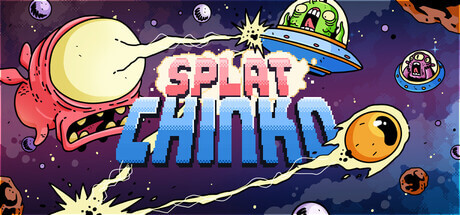
Game: Splatchinko
Genre: Casual, Indie, Strategy
System: Steam (Windows)
Developer|Publisher: Stupidi Pixel | Stratos Gaming
Controller Support: Yes
Steam Deck: Playable
Price: US $12.99 | UK £10.50 | EU € 12,99
Release Date: November 12th, 2026
Review code provided with many thanks to Big Games Machine.
Splatchinko – Plink Plonk in Space
Weird and wacky are probably the two words I’d use to describe Splatchinko. This is a game that certainly isn’t afraid to do something a little different, combining the familiar fun of arcade-style peg games with roguelike progression and a wacky space setting. It actually reminded me quite a bit of Peggle, a game I have fond memories of, although there’s a lot more going on here than simply bouncing balls around a screen.
I like the idea behind Splatchinko, and there’s definitely something entertaining about its unusual approach. However, while I enjoyed plenty of what it has to offer, I don’t think it completely pegs the landing. Some of its mechanics are difficult to get to grips with, and I found the overall experience a little inconsistent. Let’s take a closer look.
Love, Aliens And Planetary Destruction
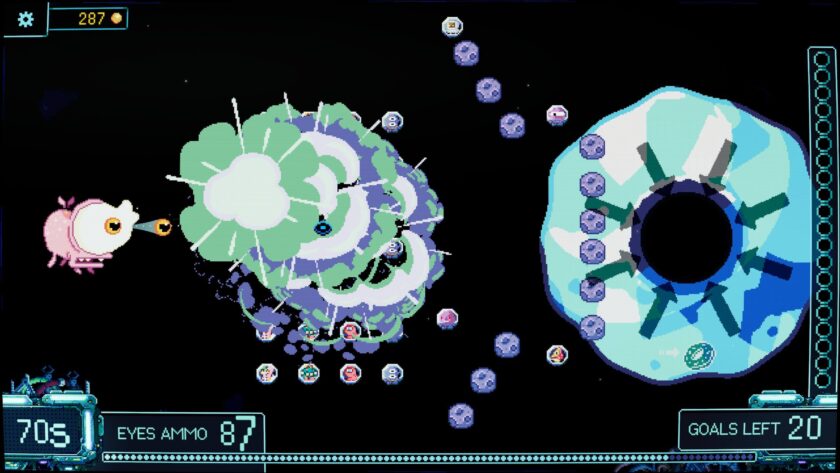
The story is every bit as unusual as the gameplay. You play as a rather strange alien whose equally strange beloved has been kidnapped by a mysterious entity. Naturally, there’s only one sensible way to get them back: travel across the galaxy and destroy every planet that gets in your way. Your weapon of choice? Your own eyeballs. Yes, really. The idea is that you launch these little eyeball projectiles towards a battlefield filled with pegs, enemies and various obstacles. As your shots bounce around, they build up damage, eventually wearing down the planet’s health until you destroy it and move on to the next challenge.
The whole thing has a wonderfully bizarre science-fiction aesthetic. There’s an assortment of strange creatures, peculiar enemies and generally odd things happening on screen. It occasionally brought to mind the sort of bizarre universe you might encounter in animations like Rick and Morty, like that show I wouldn’t say the humour grabbed me. It’s more the overall visual identity that makes an impression.
Pachinko Meets Roguelike
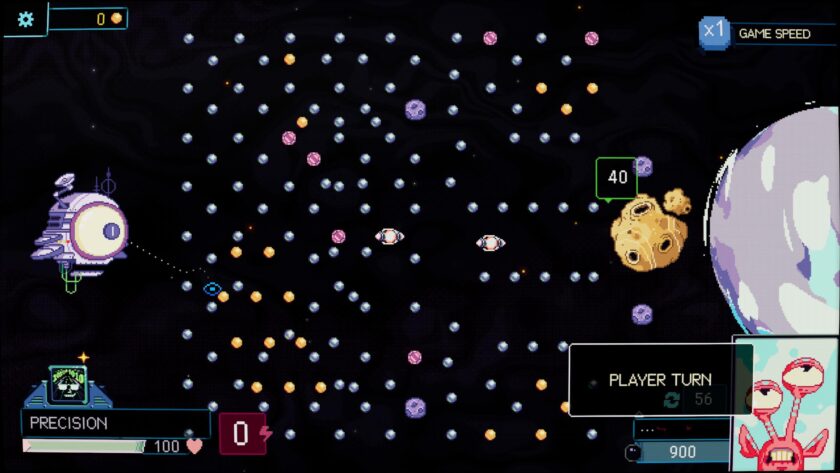
The main attraction is undoubtedly the pachinko-inspired combat. Each encounter is turn-based, with you launching your eyeballs across the space battlefield and trying to hit as many pegs and targets as possible. The more things your shots bounce off, the greater your damage multiplier becomes. There are different types of pegs to take advantage of, including explosive ones that cause additional damage and golden pegs that offer further opportunities. You can also activate switches that create black holes, sending your projectiles bouncing around in unexpected directions.
Alongside your basic supply of eyeballs, you can collect additional ones with their own special properties. Some provide damage bonuses, while others split into multiple projectiles or offer different advantages. Finding the right combination is important, as much of the strategy comes down to choosing which eyeballs to use and making the most of the turn. Once you’ve attacked, the enemy gets its opportunity to strike back, and losing all your health brings the run to an end.
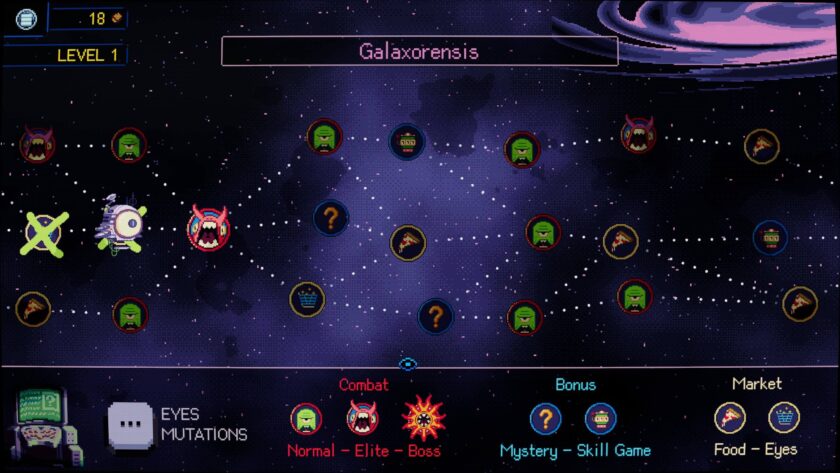
There are familiar roguelike elements here, too. You choose your route across branching maps, deciding whether to tackle battles, visit shops, take on elite enemies or investigate random events. Some encounters offer opportunities to gamble for extra currency, while others involve little distractions such as a game of rock, paper, scissors. Between runs, you can use currency to unlock additional items and upgrades that can appear in future attempts. You can also choose between different characters, each with their own starting abilities and selection of eyeballs. This gives you some variety when approaching subsequent runs and encourages experimentation with different combinations.
A Little Too Much Of A Good Thing?
While I enjoyed the basic idea, this is where I started having some reservations. My biggest issue was understanding exactly what the game expected me to do to maximise my damage. The tutorial introduces the mechanics, but I still found myself struggling to understand how some of the multipliers worked and how best to get the most out of my shots. There are lots of different effects happening, and the game doesn’t always do the best job of explaining how they fit together.
This becomes particularly noticeable when facing enemies that seem to have enormous health pools. Even relatively standard encounters can feel like a battle against a giant meat shield, requiring a surprising amount of damage to overcome. Sometimes I’d land a particularly effective combination and wipe out a planet in just a few turns. Other times, I’d spend several rounds barely making a dent. That inconsistency made it difficult to work out whether I was making poor decisions, missing something important, or simply getting unlucky. Roguelikes naturally involve an element of chance, but I would have liked a clearer understanding of how to build effective combinations and make meaningful progress.
There is an incentive to keep playing, as defeated runs allow you to unlock additional items for future attempts. However, I found the grind to reach that point wasn’t always particularly enjoyable. There were moments when I was happy to keep chipping away, but equally, I walked away from some runs feeling as though I hadn’t really achieved very much.
Visually, the game is certainly distinctive, although I sometimes found there was a little too much happening on screen. Its deliberately odd presentation won’t appeal to everyone, and I occasionally felt the overall design was a little too loud for my tastes. One thing I absolutely loved, though, was the soundtrack. It’s fantastic, with a wonderfully spacey sound and some lovely retro influences. It fits the setting brilliantly and was easily one of my favourite aspects of the whole experience.
Conclusion: Space Balls
Splatchinko is an interesting game that deserves some credit for trying something different. Combining pachinko-style physics with turn-based combat and roguelike progression isn’t something you see every day, and the basic idea is genuinely entertaining. There’s plenty of variety in the different eyeballs, upgrades and branching routes, while the soundtrack is an absolute highlight.
Unfortunately, I think the experience could benefit from some additional balancing. The difficulty and damage calculations feel inconsistent, and the tutorial could do a much better job of explaining how to build effective combinations. The progression grind also felt a little too demanding for my liking. I still enjoyed what Splatchinko was trying to achieve, and there’s enough here to keep me interested. With a little more refinement to its balancing and explanations, I think it could become an even more enjoyable experience.
Final Verdict: I Like It
Do you like our content?
Subscribe to our daily news and never miss a review!