



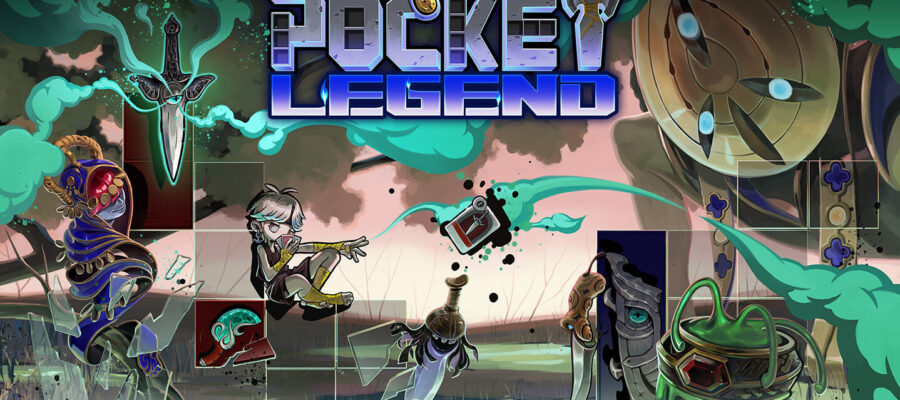
Game: Pocket Legend: Inventory Roguelike Deckbuilder
Genre: Strategy, Indie.
System: Steam (Windows)
Developer|Publisher: Shading Box | Paras Games
Controller Support: Yes
Steam Deck: Playable
Price: US $14.99 | UK £13.49 | EU € 14,99
Release Date: November 10th, 2026
Review code provided with many thanks to Shading Box.
Pocket Legend: Inventory Roguelike Deckbuilder – Finding Space
If there’s one thing we certainly aren’t short of these days, it’s roguelike deckbuilders. It seems there’s always another one arriving, each hoping to find a slightly different way of keeping us hooked for just one more run. Pocket Legend: Inventory Roguelike Deckbuilder is another addition to the genre, but it has an interesting little twist: rather than simply playing cards, you’re organising them inside an inventory grid, where positioning can make all the difference. It’s an idea that works surprisingly well, giving the familiar deckbuilding formula an extra layer of strategy. I’ve spent a fair bit of time chipping away at it, and while it takes a little while to get comfortable with its mechanics, I found it a rather enjoyable experience.
Welcome To Lumensia
The story follows Blitz, a protagonist who finds themselves transported to the fantasy world of Lumensia, a place where legendary weapons and items possess their own souls. With the power of the Inventory at their disposal, Blitz becomes caught up in a much larger adventure, facing the formidable Tanebra and attempting to uncover the secrets of this unfamiliar world. Along the way, you’ll encounter various companions and characters who help tell the story as you progress. I’ll admit that I didn’t pay an enormous amount of attention to the narrative. It wasn’t that I disliked what was being presented, but I found myself much more interested in the gameplay and figuring out how to make the most of my inventory. The story is there for those who want to follow it, but it wasn’t the main attraction for me.
Making The Most Of Your Inventory
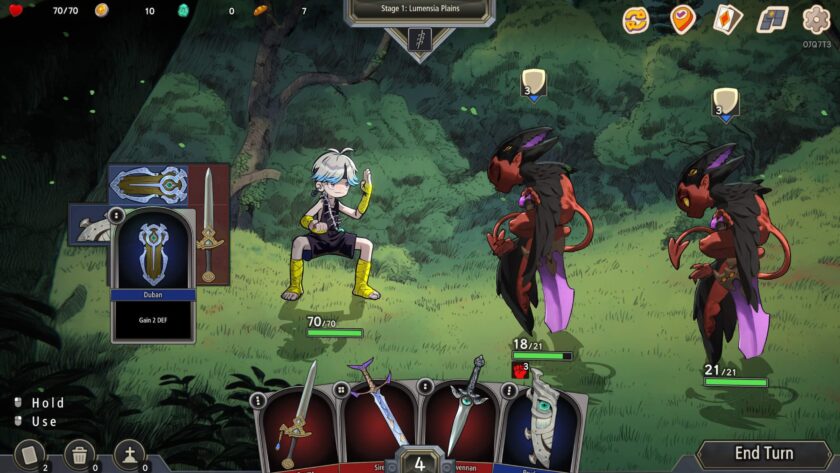
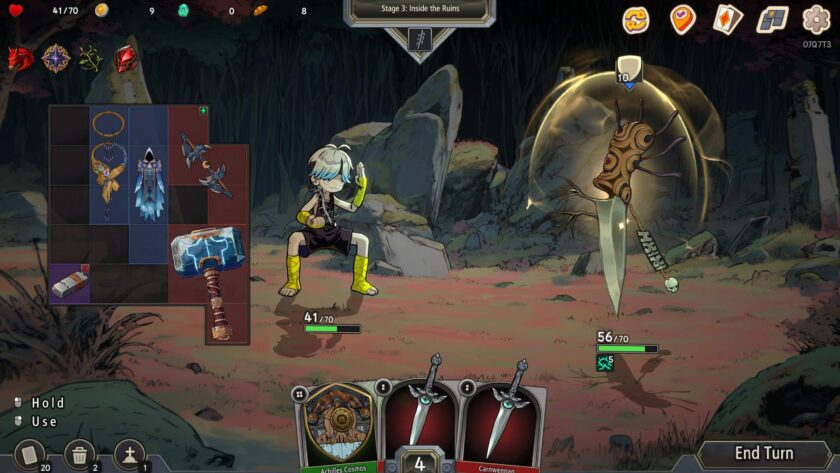
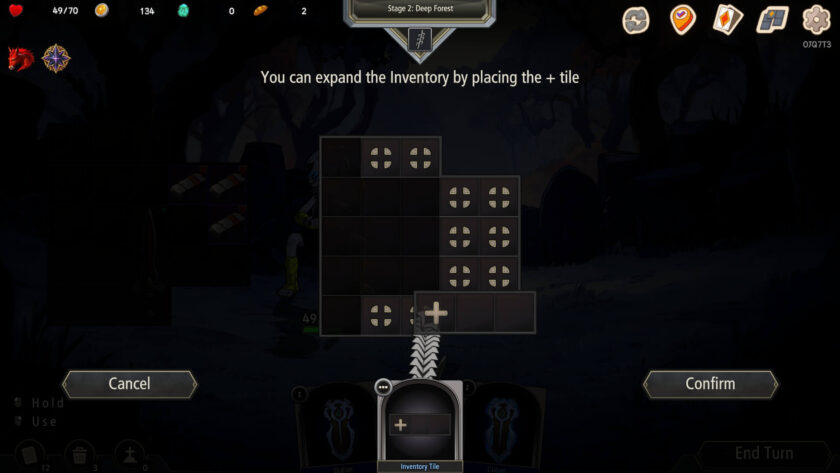
The real hook of Pocket Legend is its interesting approach to deckbuilding. Battles begin with a selection of cards drawn into your hand, but instead of simply playing them, you need to fit them into an inventory grid. Each card takes up a certain amount of space, and you can rotate and reposition them to make everything fit. Once you’ve found a suitable arrangement, you can activate the cards and unleash their effects. Weapons deal damage, armour provides defence, skills trigger special effects, and binding cards offer ongoing benefits simply by being placed in your inventory. There are also obstruction cards, often introduced by enemies, which make organising everything a little more difficult. What’s particularly interesting is that positioning isn’t just about making everything fit. The arrangement of your inventory can influence how effective your cards are. Some weapons become stronger when surrounded by empty spaces, while other effects benefit from having obstructive blocks nearby. It’s a clever system that encourages you to think carefully about where everything goes rather than simply filling every available space.
Battles are also about paying attention to what your opponents are planning. Enemies have different attack patterns, and you can usually see what they’re preparing to do next. If an enemy is about to unleash a particularly nasty attack, it makes sense to prioritise defensive cards. If they’re preparing to defend themselves, that might be your opportunity to concentrate on dealing damage. Of course, you won’t always draw the cards you need, so there’s an element of adapting to whatever the game throws at you. Sometimes you’ll have to make compromises, rearrange your inventory and work with what you’ve been given. I particularly enjoyed this aspect, as it makes each turn feel like a little puzzle to solve. Victory rewards you with gold, new cards and inventory fragments that expand your available space. Having a larger grid gives you more opportunities to experiment with different combinations, although it also means you’ll have more decisions to make.
Planning Your Journey
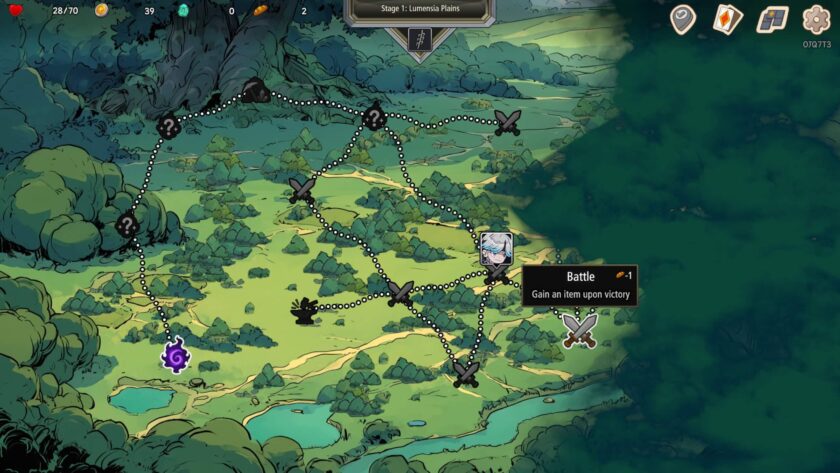
Between battles, you’ll explore a branching map filled with the usual roguelike assortment of encounters. There are shops, random events, opportunities to find new cards and various other rewards to discover. Choosing your route is important, as you’ll need to consider what might be useful before heading towards the next major encounter. One mechanic of note is the hunger system. Each time you visit a location, you consume food, meaning you can’t simply wander around exploring every available route without consequences. Once your food runs out, continuing to explore starts costing you health instead. This creates some interesting decisions. Do you take a chance on another encounter in the hope of finding something useful, or do you conserve your resources and head towards the next area? It adds another layer of planning to the experience and encourages you to think about the consequences of your choices.
Fantasy Vibes
Visually, Pocket Legend has a pleasant hand-drawn appearance, with a varied selection of fantasy creatures and enemies to encounter. There’s a decent amount of variety in the designs, and the overall presentation suits the game well. The soundtrack does its job, although it wasn’t something that particularly stood out to me. I found the controls straightforward, too. While I mostly played using a mouse and keyboard, the game also works well with a controller and is perfectly comfortable on Steam Deck. It’s the sort of game that lends itself nicely to picking up for a run whenever you have a little spare time.
Conclusions: Fits in Nicely
Pocket Legend: Inventory Roguelike Deckbuilder might be another roguelike deckbuilder in an increasingly crowded genre, but its inventory-management mechanics give it a worthwhile identity of its own. Organising cards, making the most of their positioning and adapting to enemy attack patterns creates an enjoyable tactical experience.
It does take a little time for everything to click, and there’s certainly more to learn as you progress, but once you get to grips with the mechanics, there’s plenty of fun to be had. The hunger system makes exploration feel like a series of meaningful decisions rather than simply working your way through a map. It’s not necessarily doing anything revolutionary, but I think it gets the important things right. If you still have room in your gaming schedule for another roguelike, this is one worth considering. A free demo is available on Steam.
Final Verdict: I Like It A Lot
Do you like our content?
Subscribe to our daily news and never miss a review!