

Early Review code provided, with many thanks to OLC Salon Lab.
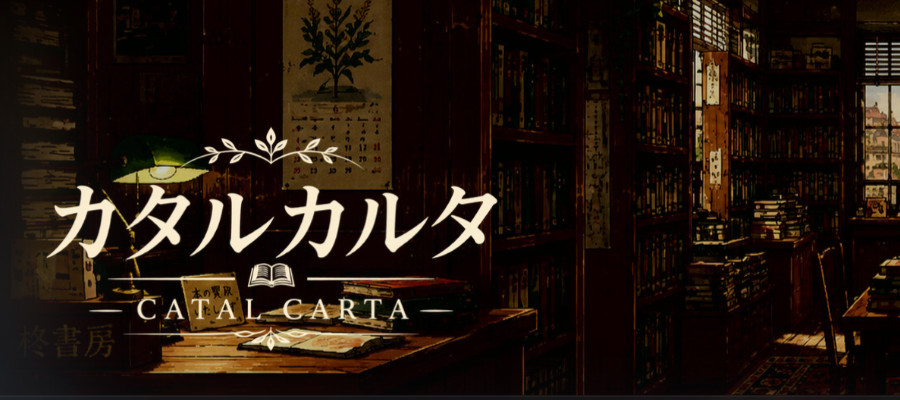
CATAL CARTA is a text adventure game where you need to solve mysteries in Japan. While there is some art, most of the game is going to be text on the screen, and you need to figure out whodunit before the end of the session.
Extremely Confusing With No Tutorial
The gameplay of CATAL CARTA is almost impossible to understand. The text, while technically correct, doesn’t supply information in a way that is helpful. There is no tutorial to tell you what you are supposed to be doing, and the interactive layer is not well-made enough to give you hints as to how to proceed.
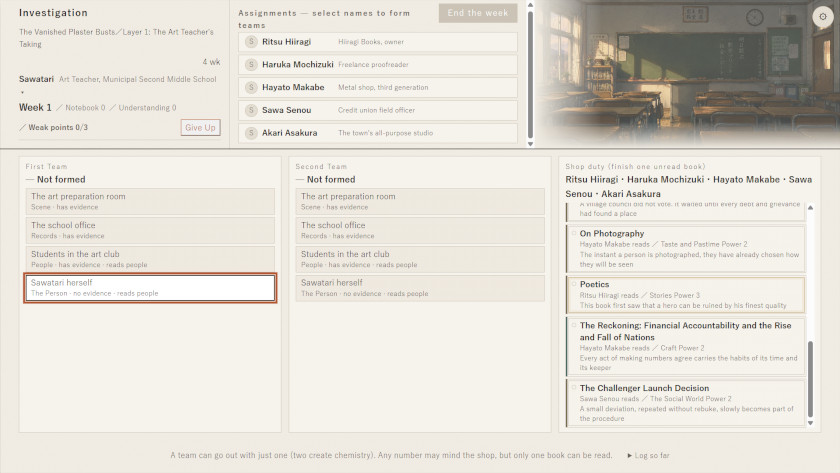
After fumbling around in the menus of CATAL CARTA for a while, I did figure out that you have a small team. Each team member needs to be assigned a location with something to do. The first mystery involves a teacher who has apparently stolen some school property. Your team of five people each have four weeks to gather up evidence.
You must assign each of the people to one of the locations, people, or evidence. But one person has to remain behind to read a book for some reason. So each week in CATAL CARTA, you send each person to study a location. If you send the wrong person for a job, there may be information remaining in that location that will require someone else to go again the next week.
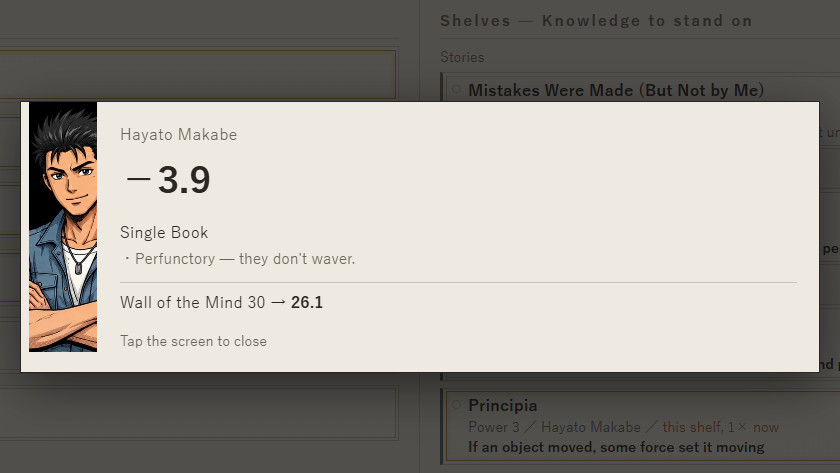
There does not appear to be any indication of who will do the job most thoroughly, so you basically have to guess and hope you have enough time to send someone else if the first person doesn’t work out. The first mystery is extremely easy, so you have plenty of people to cover the four locations while also reading a book without needing to worry about losing out on clues.
Overall, the interactions I had with CATAL CARTA were extremely confusing. I may have interrogated the suspect successfully, but I’m still not 100% sure what I did.
The Pros and Cons of CATAL CARTA
There is a lot to like about CATAL CARTA, but it is unfortunately mostly overshadowed by the bad. The cases seem to be very interesting; each one is a cute little mystery of people upsetting their neighbors, stealing small items, or other non-emergency mysteries. There aren’t any murders being solved or anything like that. It could be a pretty cozy mystery game if the issues in it get fixed.
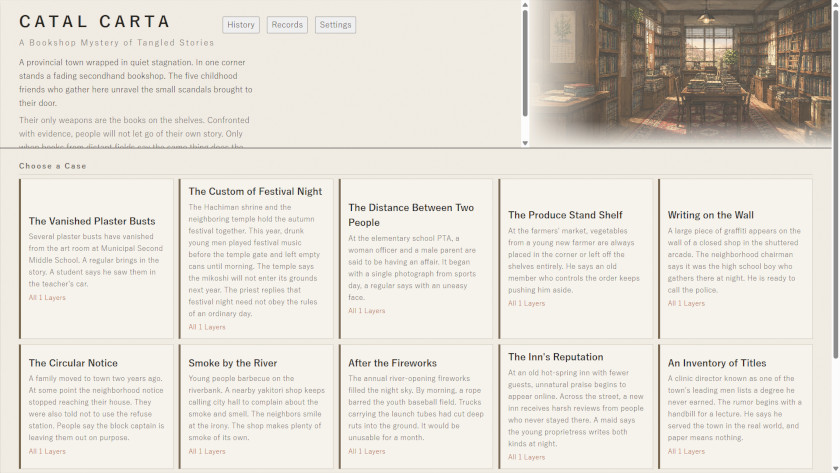
I don’t have any issue with the visuals; I know a lot of people don’t like text adventures and would prefer a GUI of some kind, but I think the visuals of CATAL CARTA are kind of charming in a way. It feels one of those choose-your-own-adventure books that were popular when I was a kid. It even has several difficulty modes so you can play how you want.
But unfortunately, I just have so many complaints about CATAL CARTA. The aggressive use of generative AI in the development of CATAL CARTA is just one of many. According to the Steam page, the developers used AI to generate character images, make the music, and translate into all non-English and non-Japanese languages. If you have been here for a while, you know that while I don’t have an issue with AI as a whole, I have massive issues with generative AI (If you don’t know, ChatGPT and other similar LLMs and image generation models are trained on stolen writing, artwork, and music, which is where my dislike mainly stems from).
Also, the language used to describe things in CATAL CARTA is difficult to interpret. Just as an example of how opaque the language is, I sent Hayato and Sawa to the school office to look for a key log of the art room. They found “last year’s budget statement” and “similar disposal cases found in the search.”
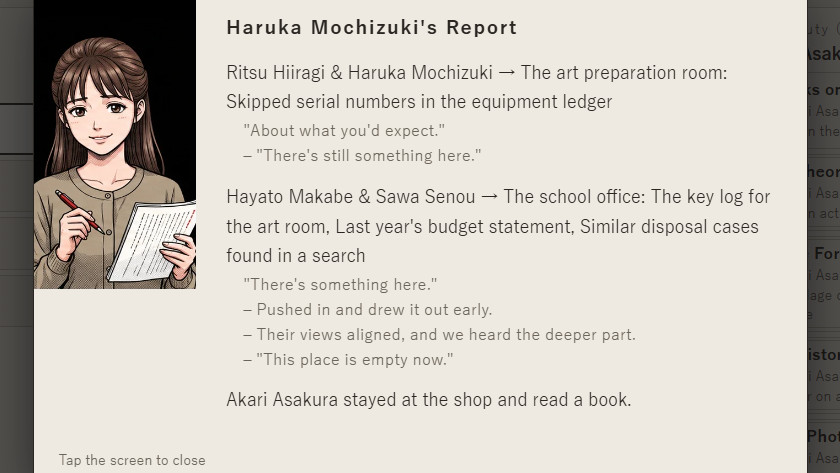
“There is something here,” Hayato and Sawa say. Then the game states that they “Pushed in and drew it out early,” and then “Their views aligned and we heard the deeper part.”
I kind of get what the text is trying to say, but it is wildly unclear when you first read it. The text is florid and impenetrable in a way that makes reading it a mystery to solve in itself; I found myself staring at a lot of the info screens for whole minutes, reading then rereading the text and feeling like an idiot. And if you think that is hard to read, you should check out the interrogation text.
Final Thoughts
CATAL CARTA is a game that suffers from poor quality testing, in my opinion. It feels like someone just made the game without having anyone else test it, then fed the text into some translation software and shipped it. It’s wildly unfinished, hard to read, and the AI-generated music is repetitive and irritating.
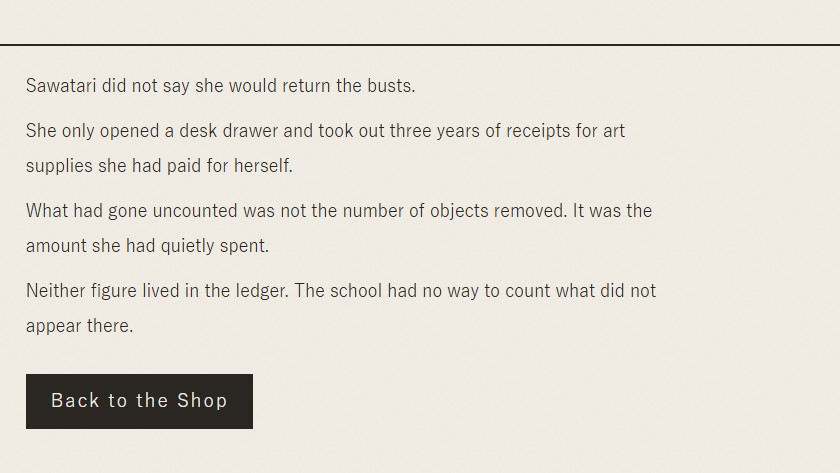
While the concept and the idea is cute and unique, I think the whole thing is basically ruined by poorly translated ChatGPT slop text, awful music, and a lack of a tutorial. I would avoid CATAL CARTA at all costs, no matter how charming it may look.
Do you like our content?
Support LadiesGamers as a member on Patreon!
 Or buy us a cup of coffee or tea on Ko-Fi!
