


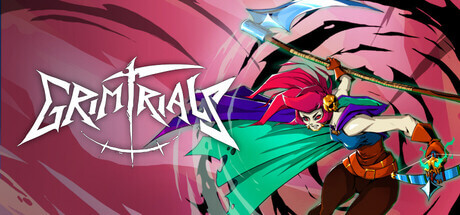
Game: Grim Trials
Genre: Action, Adventure, RPG.
System: Steam (Windows) (Also on Xbox, PlayStation and Nintendo Switch 2)
Developer|Publisher: Glory Jam | Soft Source
Controller Support: Yes
Steam Deck: Playable
Price: US $19.99 | UK £17.99 | EU € 19,99
Release Date: August 20th, 2026
Review code provided with many thanks to Goldpact Goblins.
Grim Trials, Death Has a Training Academy Now
There are some things I don’t think anyone particularly wants to discover after dying. For example, I probably wouldn’t want to discover that the afterlife involves paperwork. Finding out that I had to go back to school would be considerably worse. And yet that’s exactly where Grim Trials finds itself. You play as Avelin, a young woman who has met an untimely end and subsequently found herself recruited as a Grim Reaper. Unfortunately, becoming an agent of Death apparently requires some training, so off to the Academy she goes. From there, it’s a familiar journey of hacking, blasting, dying, collecting resources and trying again. And if you’ve spent any time with action roguelites, you’ll probably have a fairly good idea of what you’re getting yourself into. The good news is that Grim Trials is pretty good at it.
A Familiar Journey Through The Afterlife
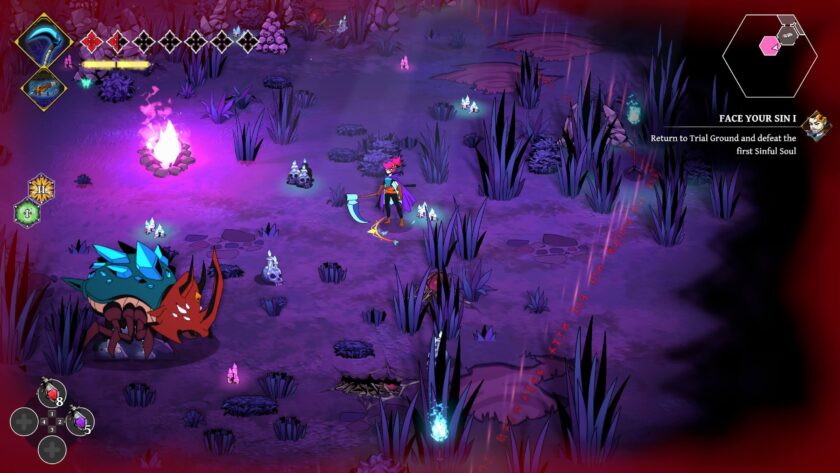
Let’s get the obvious thing out of the way first. Grim Trials is very much an action roguelite, and it’s walking along a road that has already been travelled by quite a few games before it. There’s a lot of room-to-room combat, randomised upgrades, increasingly difficult enemies and bosses waiting to ruin your day. It has some very strong Hades energy about it too. That’s not necessarily a criticism. Hades is hardly a bad game to take inspiration from, and Grim Trials does introduce enough of its own ideas to give the formula a little personality. Rather than simply wandering through a collection of randomly generated rooms, Grim Trials uses a hexagonal map system. You move between these hex-shaped areas, choosing where to go next and deciding which route you want to take. You can see the general layout of the area ahead, although I did sometimes wish the game gave you a little more information about what was waiting in the next room. There were occasions when I’d happily explore a little further, only to discover that I’d accidentally wandered into a boss encounter. Sometimes Death comes for you when you least expect it.
Give Them The Pointy End
The combat is where Grim Trials is at its most enjoyable. You begin with a suitably chunky scythe, which feels exactly like the sort of weapon a trainee Grim Reaper should be carrying. It has a satisfying sweeping attack that can hit multiple enemies, and there’s a nice weight behind the combat. You also have a ranged weapon, allowing you to keep some distance from enemies before moving in with the scythe. As you progress, you’ll gain access to additional weapons and abilities, allowing you to develop your own approach to combat. There’s also a special ability that charges as you fight, giving you another powerful attack to unleash when things get a little crowded. It all feels good. The combination of melee and ranged attacks gives you enough options to keep things ticking along. If I were to niggle, and I will, its difficulty is pretty brutal early in the game. Enemies just seem to drain health even though they have telegraphed attack patterns. Maybe it’s my old age, but I’m starting to struggle with these action games that require the precision and dodging abilities of one of those annoying flies at a picnic.
Then The Bosses Happen
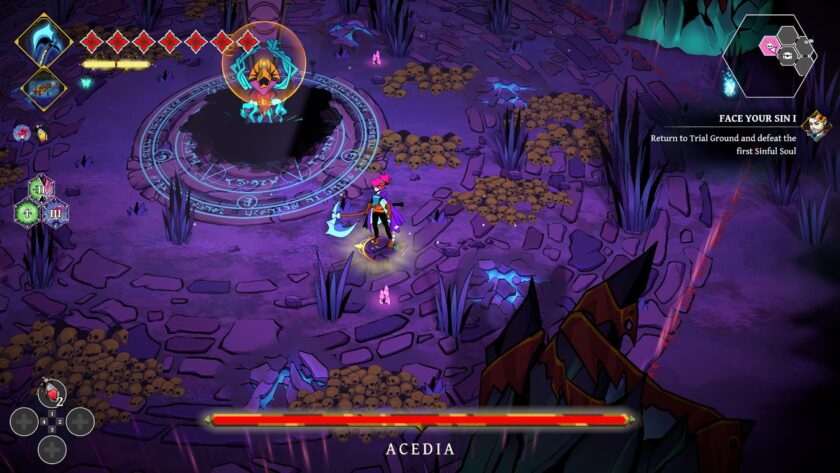
As is traditional in the roguelite world, Grim Trials has a habit of being reasonably pleasant right up until the boss appears. Bosses can hit hard, unleash multiple attacks and fill the arena with projectiles, occasionally turning the fight into something approaching a miniature bullet hell. They can also summon additional enemies, meaning you suddenly have considerably more things trying to kill you than you did thirty seconds earlier. This can be exciting, but it can also feel a little overwhelming. There were moments where I felt that success depended slightly too much on whether I’d been fortunate with my upgrades during the preceding rooms. If you have the right combination of abilities, things can suddenly click into place. If you don’t? Well, Death apparently needs more training.
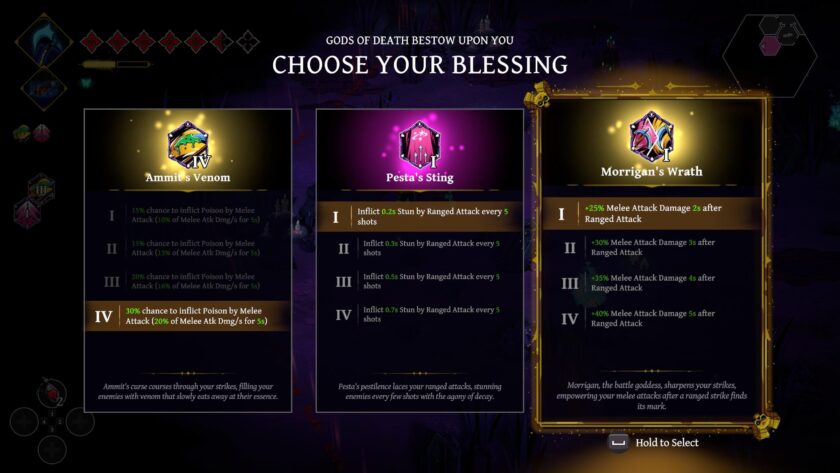
I also wasn’t always convinced that the upgrades I was offered matched the way I was playing. There are some useful bonuses involving things such as dashing, projectiles and recovering health, but I occasionally found myself choosing upgrades that didn’t really complement my preferred approach. It’s not a deal-breaker, but I would have liked to feel that my choices were shaping my build a little more consistently.
The Good Stuff Comes Home With You
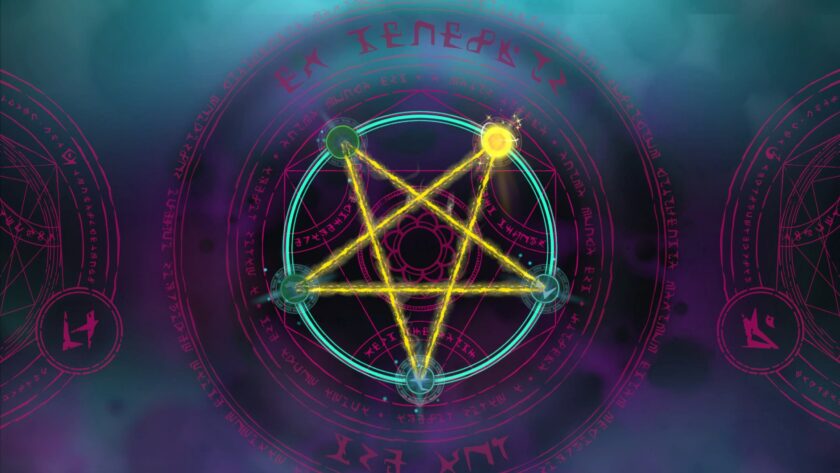
One of the things I do like about Grim Trials is that dying doesn’t mean you’ve completely wasted your time. During each run you’ll collect various materials and resources, and these remain available when you return to the Academy. This is where the longer-term progression starts to become more interesting. You can spend resources crafting new weapons, equipment and outfits, while the skill tree allows you to invest points into permanent upgrades. There’s also a forging system that allows you to rework existing equipment and reroll its statistics. Even better, crafting isn’t simply a case of selecting an item from a menu and watching a number go up. Some crafting involves a little timing-based minigame where you need to hit a button at the right moment as an indicator moves around a circle. It’s a small addition, but I dug it.
Potions Are Your Friends
There are also potions to craft, and I found these surprisingly useful. You’ve got your expected healing potions, alongside other concoctions that can temporarily improve your abilities. They’re particularly handy when you’re preparing for the more difficult encounters. Stocking up on a few useful potions before heading into another trial can make a meaningful difference. This adds another little layer to the preparation between runs. And that’s really where Grim Trials starts to come together. You go into a trial. You fight. You collect materials. You inevitably die. You return to the Academy. You craft something. You improve your skills. Then you go back and try again. It’s a satisfying loop, even if I felt that it took the game slightly too long to reach its more interesting stages.
The Academy Adds More Than Just Crafting
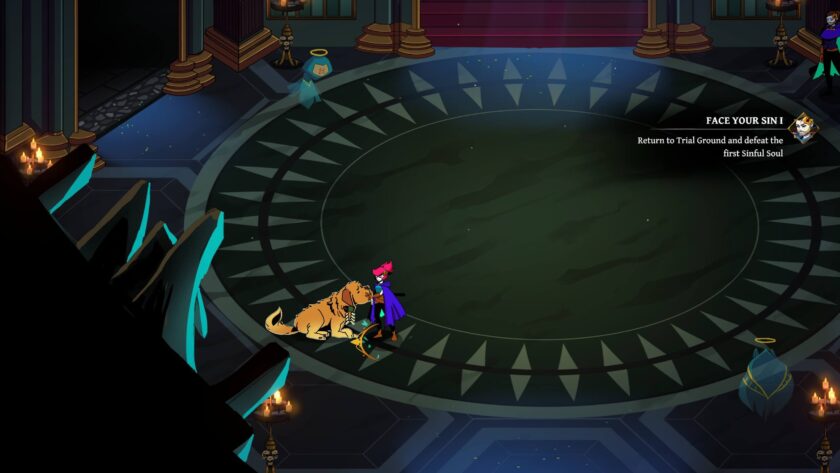
The Academy itself is also more than simply a menu screen where you spend your resources. You can interact with various characters, take on side quests and build relationships with the other Reapers. These interactions gradually unlock additional features, crafting options and resources, giving you another reason to spend time exploring the hub between runs.
A Rather Pretty Underworld
Visually, Grim Trials is probably one of the things that surprised me most. There’s a very strong stylised look here, with colourful environments and cel-shaded characters giving the whole thing a slightly cartoonish appearance. And yes, it does remind me of Hades. Quite a lot. But I think Grim Trials has enough of its own personality that I didn’t find the comparison particularly bothersome. If anything, it makes the usually rather depressing concept of wandering around the underworld feel surprisingly lively. There are bright colours, expressive characters and a slightly playful tone running through everything. It’s a nice contrast to the subject matter. You’re dealing with death, souls and the afterlife, yet the game doesn’t constantly remind you that everything is terribly miserable. Which is probably for the best. The soundtrack is interesting, sort of rock or heavy metal in tone, which then builds and then bursts into song during boss fights. I wasn’t sure if I was playing the game or jumping into a mosh pit. It’s different, I’ll give it that.
Conclusion: Don’t Fear the Reaper
I came away from Grim Trials feeling mostly positive about it. It’s not going to suddenly make every other action roguelite obsolete, and I don’t think it quite reaches the heights of the genre’s biggest names. But what is here is enjoyable and satisfying. The combat feels good, the crafting adds some welcome depth and the Academy gives the game a little more personality than simply throwing you from one dungeon into another. I particularly enjoyed the way the various systems gradually start working together. Early on, things can feel a little slow and perhaps slightly more difficult than they need to be, but once you’ve unlocked more equipment, abilities and crafting options, the runs become considerably more interesting.
If you’re already completely exhausted by action roguelites, I suspect Grim Trials won’t magically cure that particular condition. There’s simply too much familiar territory here. But if you’ve still got room in your gaming schedule for another trip into the underworld, there’s plenty to enjoy. There’s also a free demo available, which I think is well worth trying if you’re unsure whether this particular Grim Reaper has enough swing in her scythe for you. For me, Grim Trials is a solid, enjoyable addition to an increasingly crowded genre. Sometimes you just need a big scythe, some questionable life choices and a willingness to die repeatedly in pursuit of slightly better equipment. If only life was that simple.
Final Verdict: I Like it
Do you like our content?
Subscribe to our daily news and never miss a review!