
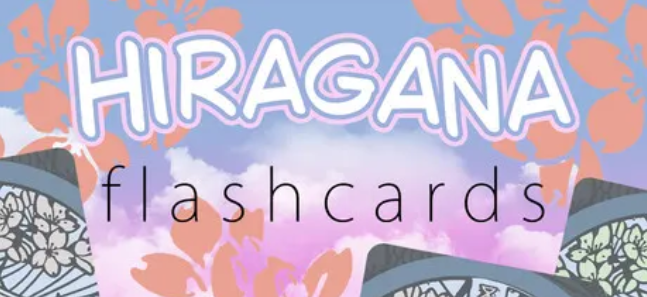
Game: Hiragana Flashcards
Genre: Education, Deck of cards, Indie
System: Steam (Windows)
Developer|Publisher: Flapbox Studios | Flapbox Studios
Controller Support: Yes
Steam Deck: No
Release Date: First quarter of 2026
Code provided, many thanks to Flapbox Studios.
What is Hiragana Flashcards about?
Hiragana Flashcards offers a simple but different approach to learning Japanese.
The goal is straightforward: master the 71 hiragana characters and gradually get familiar with the Japanese writing system. There are no lengthy lessons or explanations, just you, the cards, and your memory. It’s a minimalistic, digital twist on the traditional flashcards many of us used during study sessions.
Think of it as a small treasure hunt across the hiragana alphabet. Pick the right cards, hear the correct pronunciation, and slowly build up your knowledge.
Gameplay, trial, error and repetition
Hiragana Flashcards is extremely minimalistic. Settings are limited to just two options: volume control and the speed at which the cards appear. That’s it. No tutorial, no explanations. You’re expected to learn through trial and error.
Gameplay revolves around picking cards at random and identifying the correct hiragana. In theory, the cards are randomized, but in practice, I sometimes drew the same card three times in a row. This small quirk can be a little frustrating, but it also makes the game feel more like a genuine memory challenge.
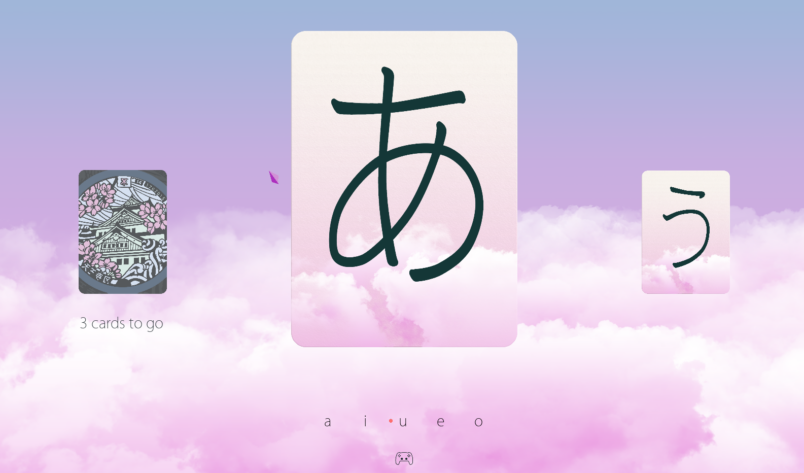
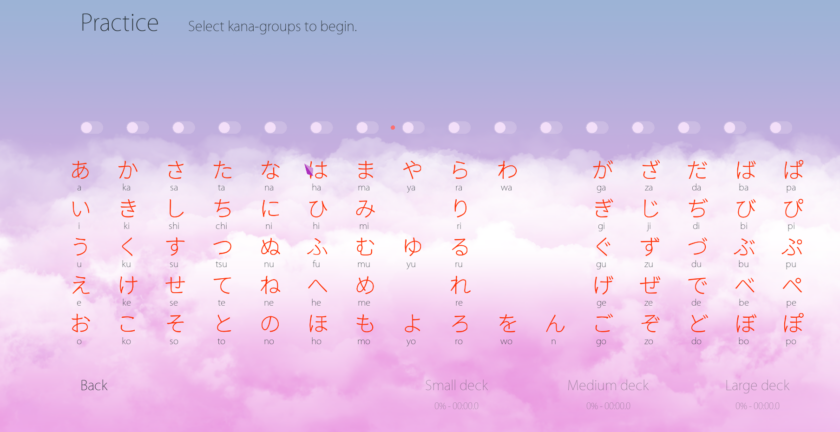
Hiragana characters are divided into groups. Most contain four characters, but a few smaller groups have only one or two. The larger groups offer a satisfying challenge, while the smaller ones feel noticeably less engaging. Still, the game encourages progression: you can select multiple groups to increase difficulty or even attempt all 16 groups at once if you’re confident.
One of the strongest features is the audio feedback. Every time you pick a card, you hear its pronunciation. This is especially valuable for learners, since mastering pronunciation is often one of the trickiest parts of studying Japanese. Mistakes are highlighted clearly, and the card lights up in red, giving instant feedback. And for achievement hunters, Steam achievements are awarded when you score 100% in each group (except the tiny groups, naturally).
Ultimately, Hiragana Flashcards feels more like a digital memory exercise than a traditional video game. The loop is simple: pick, listen, remember, repeat. And for what it sets out to do, it works.
The look and feel of Hiragana Flashcards
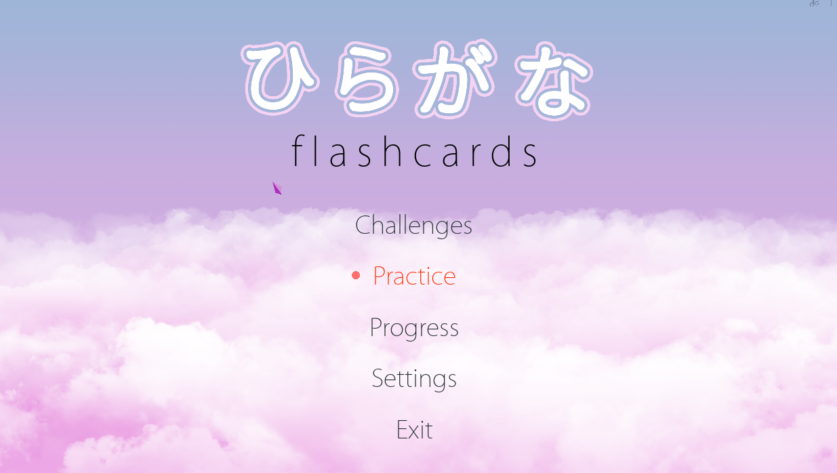
Visually, the game is very basic. There are no flashy animations or dramatic effects; the focus is entirely on functionality. The interface is clean and easy to read, which is helpful when you’re trying to memorise characters quickly.
The background music leans fully into lo-fi territory. It’s calm and unobtrusive, which fits the studying atmosphere well. However, the track loops continuously, and over longer sessions, it can feel repetitive. I found myself mostly muting it after a while, just to focus on the cards themselves.
Overall, the design emphasises clarity over spectacle. You won’t be distracted, which is good for learning, but it also means the game doesn’t feel very engaging from a purely playful standpoint.
Conclusion
Personally, I’m not fully convinced by Hiragana Flashcards. The concept is solid, and the game is clearly aimed at learners who want a simple, structured way to practice hiragana. But for me, the fun factor was mostly missing. It often feels like you’re stuck on the first level, with very little progression or challenge beyond repetition. I would have loved to see additional features, such as combining hiragana to form simple words or mini-games that test writing skills. These additions could make the experience feel more like a game and less like a flashcard drill.
That said, the game has value. For anyone looking to learn Japanese in a stripped-down, low-pressure way, it can be a helpful tool. The audio feedback and simplicity make it approachable for beginners, even if it doesn’t offer long-term engagement for players looking for a “video game” experience.
I’d love to hear what others think. Did it help your learning sessions? Or did it feel too repetitive after a while?
Final verdict: I’m Not Sure. 
Do you like our content?
Subscribe to our daily news and never miss a review!
Heya Laurane,
Veldin from Flapbox Studios here,
Thank you so much for your revieuw, I’ts my first one for this game.
It genuinely made my day to read about your experience playing my little Japanese learning game.
I’ve tried to take several of your suggestions to heart and pushed a new patch that addresses some of the things you mentioned. (Including deck repetition and clearer music feedback).
Thanks again Laurane, you helped us make the game better
Hi Veldin,
Glad you enjoyed the article. Happy to help 🙂
Best of luck for what’s forward !