


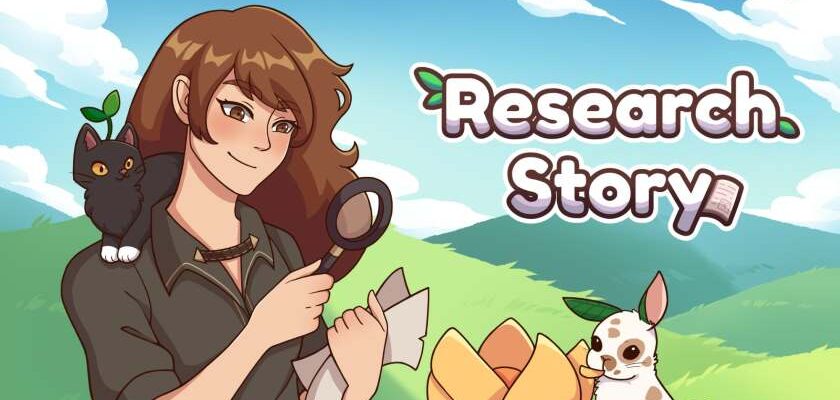
Game: Research Story
Genre: Simulation, RPG
System: Nintendo Switch (Also on Steam (Windows))
Developer | Publisher: Petal Cat Games
Age Rating: US 10+ | EU 3
Price: US $14.99 | UK £12.99 | EU € 14.49
Release Date: August 27th, 2026
Review code used, with many thanks to Petal Cat Games.
Research Story was released into Early Access in February 2023, and now, a year after its full release on Steam, it has made its way to the Nintendo Switch.
At its heart, Research Story is a farming simulation – there are crops to grow and animals to nurture, but let’s find out why it’s called Research Story, and not “Another Pixelated Farming Game!”
Heading to the Research Academy
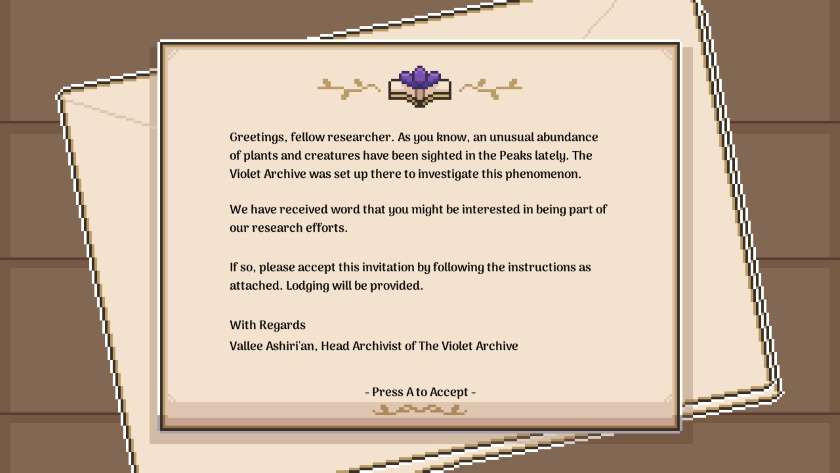
In a growing trend of moving away from inheriting a farm, Research Story invites you to assist with the investigation into the numerous plants and creatures that have appeared in the Peaks region, making your base in the town of Shimmerbrook.
You get to create your character from a wide selection of different hairstyles and colours, tops, bottoms, and bags, as well as skin tone and facial features. My only criticism of the character setup is that the avatar is quite small, so some of the nuances between the different options are sadly lost. However, the final result is a cute pixelated character.
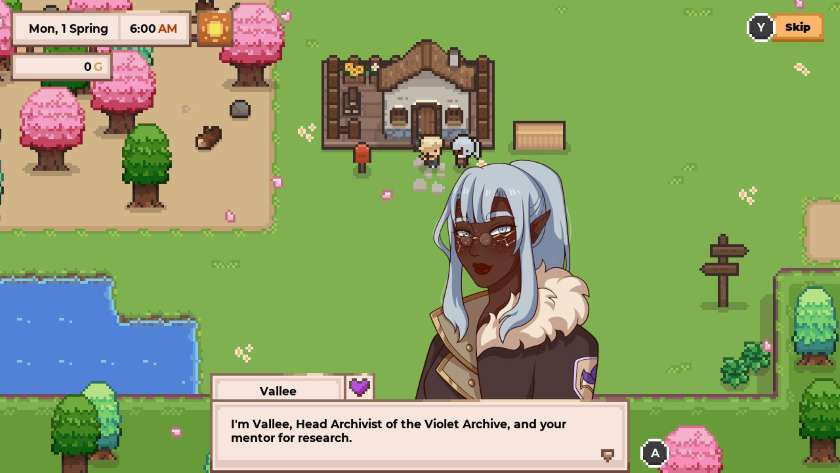
Vallee presents you with a research journal to record all your findings, and you’ll find tools inside your small house. She will also encourage you to go and meet Rhea, who specialises in taming and raising animals, as well as meeting the other researchers at the Violet Archive in town, each with their own field of expertise.
Soon you’ll be chatting with the many residents of Shimmerbrook, increasing your friendship levels, and paying close attention to the conversation for clues to their favourite items. During your first few days, some residents will give gifts, like a chest, crafting recipes, and a fishing rod. Others will hint at things to come, like teleportation, automation, and mysteries to unravel. As your friendships blossom, there are cutscenes expanding their background stories, and the opportunity to hang out together and even get married.
The Research in Research Story
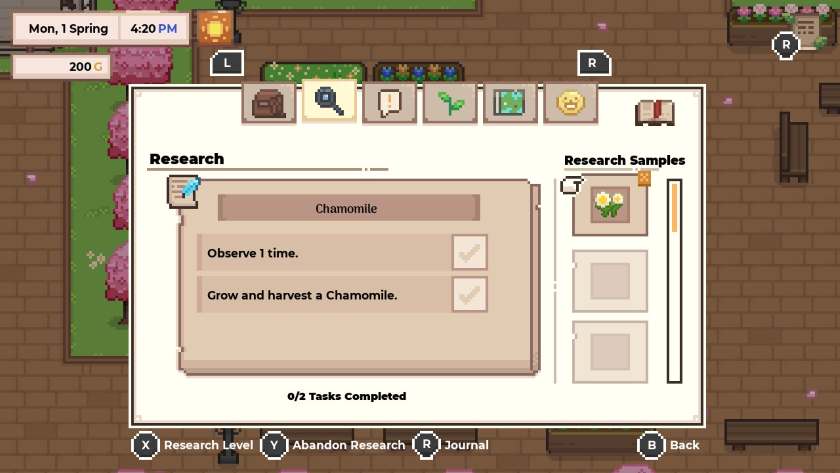
There are no farm or seed shops in Research Story, so before you can raise an animal or harvest a crop, you need to carry out research. This is primarily done by observing how the creature lives or where the plant grows, then using that information to tame and befriend the creature, or gather seeds to sow and produce the crop. Once befriended, animals will give additional produce, along with a perk that is active when they are following you.
You initiate the research by using the magnifying glass in your inventory, and the research tab shows what tasks need completing. If necessary, you can “abandon” any of your current research (especially useful as some plants take 10+ days to grow), and when you are ready, you re-initiate it with a fresh sample, keeping your previous progress. To start with, you have 3 research slots so it’s an added challenge of balancing what to research and when.
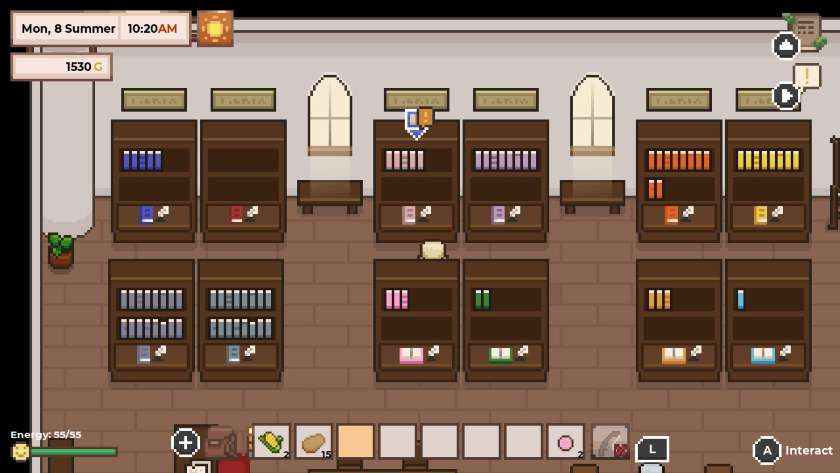
The finalised research notes are handed in at the Violet Archive, and as you increase your research level, you’ll unlock other opportunities, like more research slots, job requests, and exhibition cases. You can also read the notes your fellow researchers have handed in, and over time, the Archive’s bookshelves will fill up. It’s a great touch and makes the Research Story world feel active.
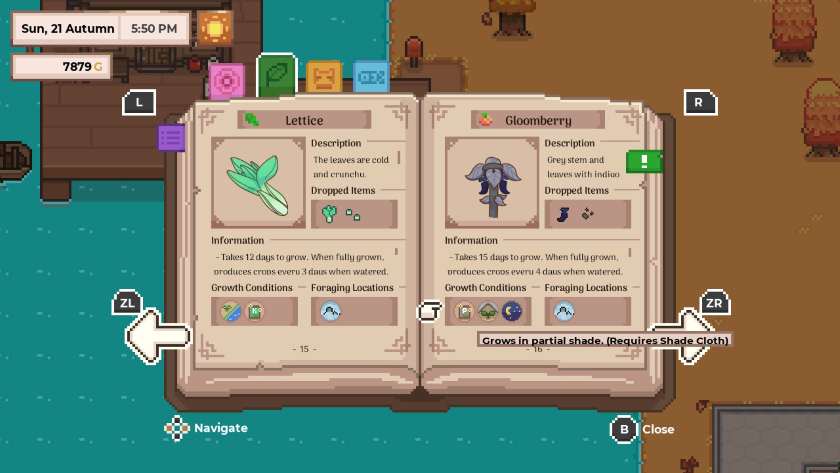
Research Story has a well-balanced approach to learning how to research. At the start of spring, there are just a couple of flowers and creatures to discover, and the requirements for success are simple. However, as the month progresses and new areas unlock, more plants and animals appear. This time the requirements might be more challenging, like needing shade for the crops, or observing animals in different locations. Eventually, you’ll need to use different soil types and fertilisers, and look for animal tracks or behaviours. However, nothing in Research Story feels overwhelming; quite often you’ll be gifted the items you need, as well as the recipe to make more.
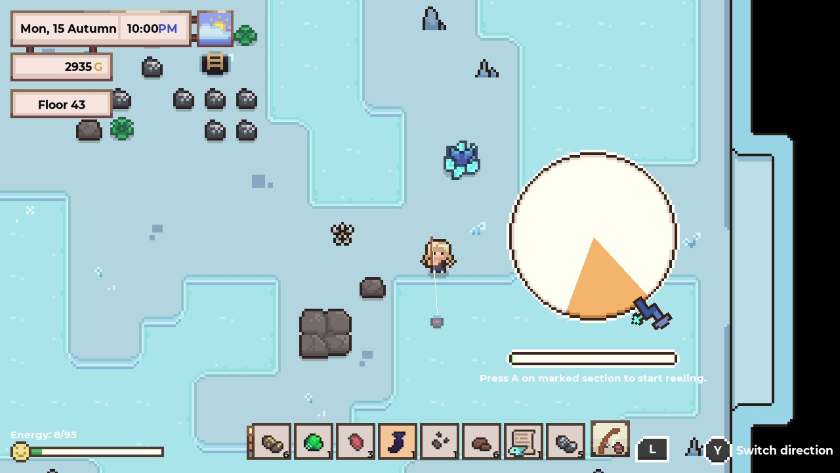
In addition to plants and animals, some of the many fish around the Peaks need researching. The process is similar, although you must use the Origin Tracker in the Fishing Shack before you can start the research. This will identify the location of the fish and the type of bait needed to catch it. The fishing mini-game is straightforward: cast your baited line, start to reel in when you get a bite, and continue to reel in when the fishing handle is over the catching segment.
More Than Just Research
Mining plays an important role in Research Story. In addition to finding and recording the numerous creatures and plants, you’ll gather gems. Gems are a good source of income, but they can also be used to create mana cells, a power source needed to operate the mine elevator, farm teleporter, and preserver. If you own an upgraded trowel, you can dig up furniture or uncover gem-filled levels. Breaking crates or pots might result in discovering a pristine parchment featuring its own little riddle and reward.
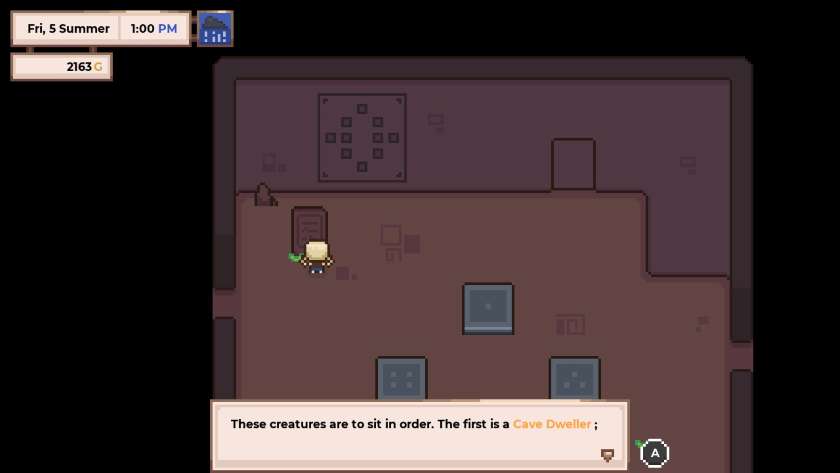
Both the cave and mines have puzzles to solve. The puzzles have been designed to be completed as the year progresses, so the first mine puzzle uses spring items, the second has a summer influence, and another needs a winter item. I wasn’t expecting to have this extra level of intrigue in Research Story, but I am delighted that there is a mystery.
It’s not all work and no play in Research Story! The local tavern, Mugs and Darts, is a great place to socialise (and improve your friendship levels) after a busy day. Lisa sells a small selection of meals, which is useful as you can’t cook your own food until you upgrade your house and own the appropriate kitchenware.
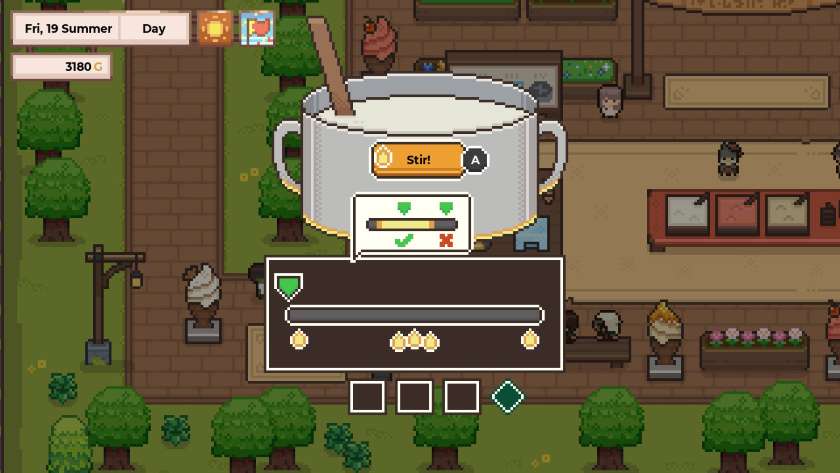
Each season has a festival to participate in, from writing spring poems to throwing snowballs. I enjoyed making ice cream at the summer fair, with its little set of mini-games to create the icy treats. There is the added bonus of being able to take them home at the end of the day, if you haven’t handed them out as gifts.
Play It Your Way
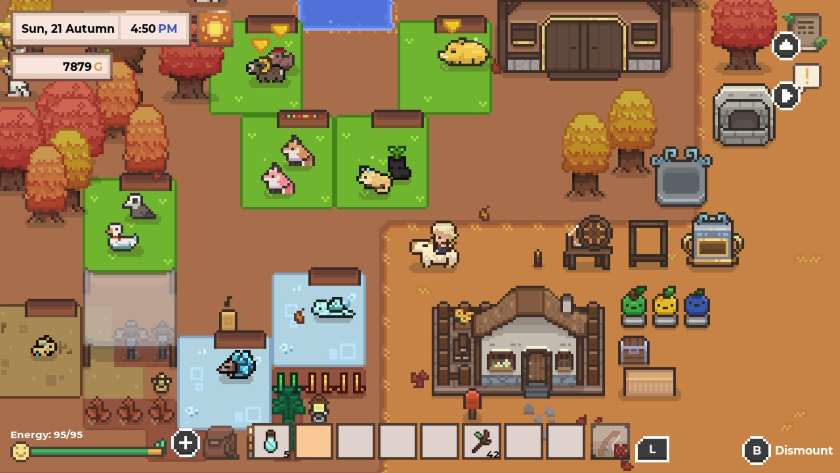
Research Story is full of thoughtful quality-of-life options. At the start of a new game, you get to select whether to play “normal” or “relaxed”. “Relaxed” gives immunity to the harsher conditions found deep in the mines, makes sure the animals don’t get unhappy if there is no food, and makes upgrading and other purchases cheaper.
Maybe you’re fed up with running out of daylight hours? If so, simply increase the length of the day. Time already stops when searching through chests, but you can even pause it while indoors. If you struggle to find that certain NPC, you can turn on the tracking option. Alter the setting so you don’t faint when you run out of stamina, and my personal favourite is the option to stop the clock at 2 am; the shops might be shut, but the mine is still open for exploration. All of these options can be turned on or off during the game.
However, there is more to Research Story’s cosy gameplay than just its settings. Although you need bait to fish, it doesn’t always get consumed, and you only expend energy when you catch a fish, not when you fail or reel in other items. The scythe doesn’t deplete your energy, and you can use it to break open containers in the mines. Trees drop plenty of saplings, and there are lots of items available to forage. The main map gives information about the opening times for the shops, and the fishing map shows where and when the regular fish can be found. There are various crafting stations dotted around Shimmerbrook, so you don’t have to make your own to start with.
Gameplay
The controls are comprehensively explained, shown on the screen as needed, and the options menu gives a full breakdown. It is possible to re-map any or all of the buttons. It can feel slightly awkward to move around some of the dial menus, especially with the use of the shoulder buttons and the left stick movement is marginally over-sensitive, causing me to make an undesired response during an NPC conversation.
The text size is generally large enough to comfortably read on the small Switch Lite screen, with the exception of the journal, where it is bordering on being too small. There is no touchscreen functionality.
Most of my 50+ hours of gameplay was on the original Switch in docked mode, and I didn’t encounter any frame-rate issues, and the loading time between areas is refreshingly quick. I did spot that the resource input graphic for the furnace is the wrong way round for ore versus coal, but apart from that, Research Story is a very well-polished game.
The game autosaves overnight, but there is a separate manual save which can be used at any point. With the default settings, it takes around 20 real-world minutes to complete an in-game day. However, with the quality of life options discussed earlier, it could last a lot longer.
Conclusion
I’ve played several great games this year, and Research Story is definitely vying for the top spot. It combines foraging, farming, and mining into a clever gameplay loop that builds on your gained knowledge as you progress through the seasons. Couple that with fishing, cooking, crafting, and romance, plus a handful of clever puzzles, and the resulting game is an all-encompassing simulation.
Research Story has definitely gained its Master of Perfection from my University of Gaming!
Final Verdict: Two Thumbs Up 
Do you like our content?
Subscribe to our daily news and never miss a review!