



Code provided with thanks to HeroCraft PC
Chronocracy- A Fresh Spin on City Building
City builders and strategy games have been around for years, so it can be difficult for a new one to immediately stand out. After spending some time with the Chronocracy demo, I came away feeling that this might just have the ingredients to do exactly that.
Rather than simply asking you to place buildings and watch numbers go up, Chronocracy mixes real-time strategy, resource management, exploration and even a touch of roguelite progression into one ambitious package. It’s certainly trying something different, and while I occasionally found myself scratching my head trying to understand everything it was throwing at me, I also found myself genuinely intrigued by what the full game could become. It isn’t the easiest game to jump into, but there’s definitely something interesting here.
Tiny Tribe, Big Responsibilities
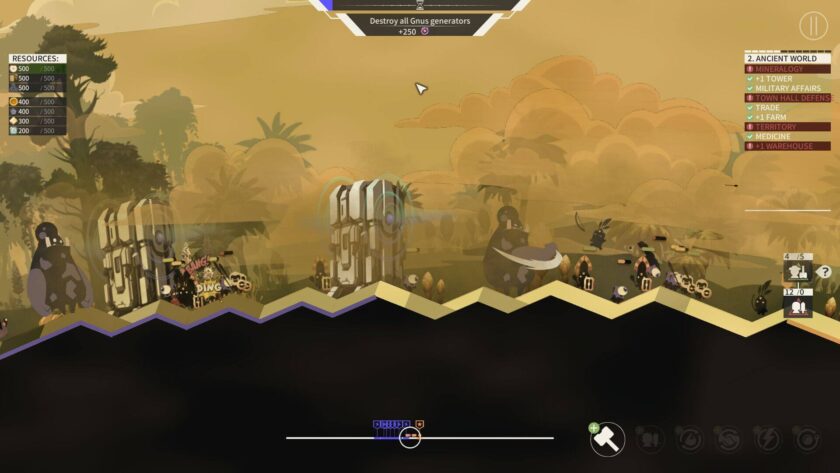
The basic premise is this. You take control of a small civilisation living on a flat world, gradually transforming a handful of tiny villagers into a thriving society capable of surviving increasingly dangerous threats. The first thing that immediately caught my attention was the presentation. The little black blob-like villagers instantly reminded me of Patapon, a popular PSP game also remade to modern systems not too long ago. They run around making amusing little noises while carrying out your orders, giving the whole game a welcoming personality.
I really liked the world’s design. Rather than managing a sprawling landscape stretching off into the distance, everything takes place across a small circular planet that you can rotate around freely. Being able to see your entire little world at once gives the game a unique identity and makes it cool to watch your civilisation slowly expand across its surface. Each planet also introduces different environments, creatures and challenges, helping things feel varied even during the demo.
More Than Just Building Houses
Like most city builders, your first priority is survival. You’ll gather food, chop trees, mine stone and gradually unlock more advanced buildings to support your growing population. Farms, houses, workshops and defensive structures all become part of your expanding settlement. What I particularly enjoyed was the underground mining system.
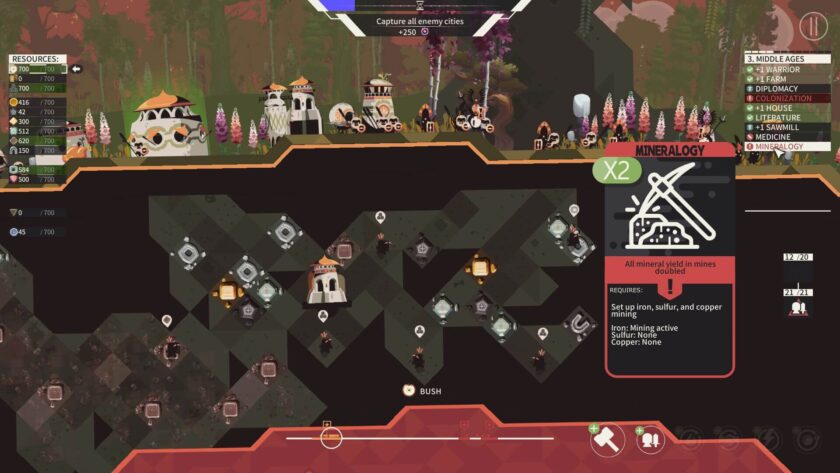
Rather than simply clicking on resources and forgetting about them, you can actually descend beneath the surface and watch your workers mining away inside the planet itself. Being able to manage both the surface and underground at the same time gives Chronocracy a different feel compared to many other strategy games. As your civilisation grows, so does your military. Eventually you’ll need to train soldiers to defend against enemy attacks while also launching assaults against rival settlements as mission objectives become more demanding. It’s enjoyable progression that constantly gives you another goal to work towards.
Plenty To Think About
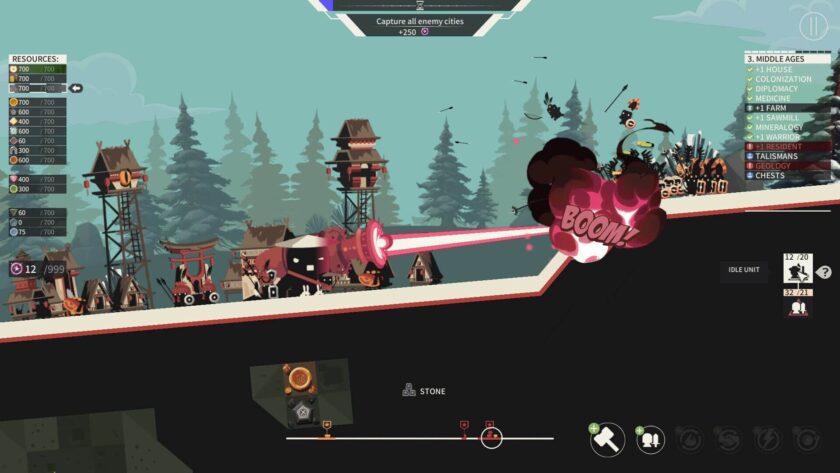
There is a lot happening at any given moment. Research unlocks new technologies. Resources constantly need balancing. Workers require managing. Buildings need constructing. Enemies keep appearing. Objectives are ticking away against a time limit. It’s certainly never boring.
Between missions there’s also a permanent progression system where you spend earned resources on upgrades before starting your next run. It has a slight roguelite flavour without completely changing the city-building formula, which I thought worked quite nicely. There’s clearly a lot of depth waiting beneath the surface.
The Learning Curve Is Real
This is where my biggest criticism comes in. Despite featuring tutorials, I still found myself becoming quite confused during several parts of the demo. The game introduces new mechanics very quickly, often before I’d fully understood the previous one. For example, I initially believed certain mining blocks required specific instructions before eventually realising workers would continue gathering resources automatically if there were available deposits nearby.
Likewise, enemy attacks sometimes arrived while I was still trying to understand the basics of town management, leaving me feeling slightly overwhelmed rather than challenged. It wasn’t that the systems were necessarily bad. There were simply so many of them arriving in quick succession that I rarely felt like I had time to breathe. I suspect experienced strategy fans will settle into everything much faster than I did, but newcomers may find the opening hours a little intimidating.
A Few Small Things I’d Like To See
One feature I kept wishing for was a more relaxed mode. Objectives are tied to timers, encouraging efficient expansion and constant decision-making. That’s perfectly understandable for a strategy game, but I also found myself wanting an option where I could simply experiment with building my civilisation at my own pace before worrying about optimising everything.
The upgrade interface also took a little getting used to. Unlocks appear almost like a checklist, encouraging you to work through numerous improvements fairly quickly. While it certainly provides clear direction, I occasionally felt like I was ticking boxes rather than naturally discovering my own strategy. These aren’t major complaints, but they did contribute to that feeling of information overload during the demo.
A Promising First Impression
Even with those criticisms, I genuinely enjoyed my time with Chronocracy. Once the various mechanics started clicking into place, there was a real sense of satisfaction watching my tiny civilisation slowly become something much larger. The presentation is full of charm, the rotating planet is a clever idea, and the combination of city building, exploration and real-time strategy feels refreshingly different.
It’s not often I finish a demo thinking, “I still don’t fully understand everything… but I really want to keep playing.” That’s where Chronocracy left me. If you’re already a fan of city builders or resource management games, I suspect you’ll settle into its systems much quicker than I did. If you’re newer to the genre, be prepared for a fairly steep learning curve, but don’t let that put you off completely. There are some genuinely clever ideas here that deserve attention.
The demo already shows plenty of potential, and with a little extra refinement to help ease new players into its many systems, I think this could become something quite special. I’m certainly looking forward to seeing where it goes from here.
Do you like our content?
Subscribe to our daily news and never miss a review!
Chronocracy looks like a really interesting mix of city building, resource management and real-time strategy. I especially like the idea of managing both the surface and the underground of the planet — that seems to give the game a nice twist compared with more traditional city builders. The learning curve sounds a little intimidating, though, so I hope the developers improve the onboarding before release. I’ll definitely keep an eye on this one.