



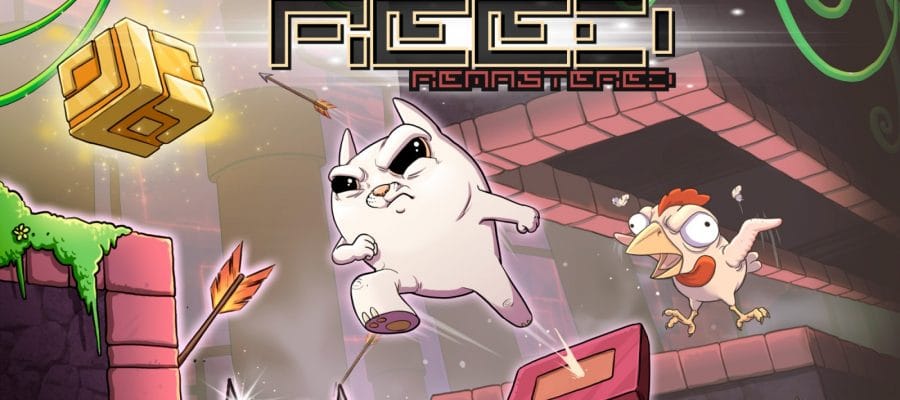
Game: Reed Remastered
Genre: Platformer
System: Nintendo Switch (also on PS4 and mobile)
Developers|Publishers: PXLink| Ratalaika Games
Price: US $4.99| AU $6.39|CA $ 5.03|£4.99 | €3,99
Age Rating: ESRB E | PEGI 3+
Release Date: 14 February 2020
Review Code used, thanks to Ratalaika Games
Reed Remastered is a game I hadn’t expected to review, it is also a game which I hadn’t expected to enjoy.
Mobile to Switch Ports
At the moment, anyone with a Nintendo Switch knows how saturated the eShop is. It seems that on a weekly basis there’s some new sale of ported Android OS-to-Switch games. While this is all fine, the main issue arises when the games are poorly ported or when they aren’t enjoyable games to begin with and become the equivalent of bloatware.
Initial Impressions
Reed, thankfully, is not amongst those games. While it is a port of a mobile game, its mechanics and controls have been designed after those of console-based platforming games. This has made the transition to home-console seamless and has lent itself to having a solid foundation.
Reed is a very middle-of-the-road game, by this I mean that it isn’t mind-blowing, but it also isn’t terrible and this isn’t necessarily a bad thing, it delivers on decent 2D platforming.

One small thing. I highly recommend turning off the screen shaking. It’s obtrusive and the game became more enjoyable once I turned it off.
The story goes that you’ve been created by a central computer in its last hopes to help repair the world around you by gathering small golden pieces. While your origin story is given, the genesis of your cat body explained, the origin of your chicken enemies is not. Though the game never really lingers on it, the only story focused moments being at the very beginning and end of the game.
A Flash to The Past
Reed reminds me of the flash games I used to play in my childhood and adolescence. I genuinely believe many of these games are, in the grander scheme of things, overlooked. It reminds me of flash games I used to play, and I most certainly do not mean that as a negative comment.

It’s interesting to note how many of today’s game makers first tried making games in Adobe Flash or other more accessible models (the pico-8 comes to mind).
It’s more interesting to think about how many players (children, adolescents, and adults alike) all cut their teeth on flash games.
In my bio I list handheld games as a large influence, and while this is true, it’s a statement that overlooks the large amount of flash games I would play in school, during breaks in a teacher’s classroom. I’d be huddled around a computer with a whole group of kids, we were all intent on showing each other our favorite flash games or doing speed runs to see which of us was fastest.
Keeping 2D Alive
It’s not a stretch to argue that in the 3D era after 5th Gen consoles (PS1, N64, Saturn) Flash Games helped to keep 2D alive. Of course, Nintendo’s DS hardware did the heavy lifting, but the independent content creator community found a home on PCs.

While many of these games aren’t stylistically groundbreaking, the good ones always put their efforts towards having tight mechanics, the “ol’ reliable” of 2D games.
Two Superstar Examples
I need only bring up Meat Boy, the 2008 Flash precursor to Super Meat Boy. That was a key moment. Stylistically it was “there” as well as mechanically. It was difficult, the kinds of difficult flash games were allowed to be. In this sense, flash games often inherited the Arcade difficulty. There was a feeling that “because this is free, I can make it as difficult as I want”. Eventually the follow-up title, Super Meat Boy, was made, it was polished, it was worked down to a fine edge, it was punishingly difficult, and it’s still lauded to this day.
The PICO-8, which I mentioned earlier, while not Flash based, is a virtual console which never existed. It’s meant to be an exercise for game designers to place themselves in an environment which is limiting and pushes their games to be efficient as well as the best it can be. In a sense, it’s a more formalized way to approach the design model which Flash inevitably creates. They overlap in the way they make games boil down to their essentials.
Celeste, a game which I could talk about to no end, saw its start on the PICO-8. If you play that original version, you’ll realize that mechanically it’s almost all there. However, when they moved the game into a larger production, they realized they could make it bigger, make it better.
They added story, they added improved handling, and kept the looseness of certain hitboxes because they realized that was a mechanic inherent to many great platformers. But they also put their spin on loose controls and built it in to late game moves/mechanics.
They also made the difficulty curve immense but always achievable. Lastly, they created a few iconic boss battles which add texture to the whole game while never giving a break and never giving an inch on difficulty. I could go into depth with each of these concepts, but I digress.
Mobile: The Inheritor of Flash?
I’ve entered into this whole spiel about flash games because I want you to understand why Reed, despite being solid, despite having a decent soundtrack, falls short. Don’t get me wrong, at its price point I think it’s worth checking out if you’re a fan of platforming and are looking for a challenge of around 2 hours (give or take).

I bring up flash games, because my main gripe is “this can become so much more”. I want you to understand that when I nitpick this game, it’s because we shouldn’t be satisfied with just saying “it’s a good port of a mobile game” but that we should push games to be better (even if they’re already good) especially when they move to more capable hardware.
This being said, despite enjoying this game, and despite my final score being positive, I have to get into the details, few as they may be.
Hitboxes
Hitboxes are an essential feature of any platformer. However, creating a perfect hitbox is not as easy as we may think it is. Too loose and a player will go through with ease. If a hitbox is too tight it will make it feel like the slightest touch against a spike will kill you, even if your sprite brushes against it unintentionally.
Reed suffers from the latter. If I land right next to a spike and survive, I feel like I executed a jump precisely. However, by turning around, the animation sprite of my character hits the same spike I managed to avoid. I die. This leaves a player with a feeling of unfairness and dissatisfaction.
The issue here is that the hitboxes in Reed Remastered, from what I can tell, feel like they are set precisely to the outline of a sprite. I might be wrong about this, but regardless the game feels like there’s no space for error. Especially when the error is caused by its own sprite animations. I can’t say how many times that kind of death made me feel frustrated. Don’t get me wrong, I would have been equally frustrated if the game had very loose hitboxes and I could glide through levels easily.
Story
While a story isn’t necessary to making a good platformer I feel as though, on a console, it should be a given that a game features ANY story, an exception to this is party games or multiplayer fighting games (and even both of those genres have installments with stories). Even if it isn’t amazingly well written, a console game should feature a story of some sort. While Reed Remastered does offer those two scenes at the beginning and end of the game, it could have done more to fulfill what is a standard for console games, port or otherwise.
Difficulty & Difficulty Curves
While hit boxes are a balance, they’re also a smaller part of a whole. The whole being difficulty and difficulty curves (these are different from one another). If we look at a game like Celeste, it has been praised for both.
Difficulty can be described, in platformers, as the amount of skill it takes to overcome the challenge in one single room or screen. It depends largely on where respawn points are placed and whether the game breaks sections into rooms or treats each room or screen as an independent area.
Difficulty curves, on the other hand, can be described as the intensity and variation of skill that the game expects you to overcome from level-to-level.
Celeste offers rooms that are very difficult, but because it has a difficulty curve which is progressive, each room usually feels like a tiny step rather than a large leap in skill. This culminates into an experience which uncoincidentally is very much like climbing a mountain. On a long hike you start and each step goes before the next, maybe 2-4 hours later you’re staring down from a mountainside and you can’t help but think “I didn’t really hike a whole mountain, I just hiked one step after another”.

Unfortunately, Reed Remastered lacks a difficulty curve. This sounds off, but I suppose what I really mean is that its difficulty curve is arbitrary and lacks design.
At times I would go from beating rooms that were relatively easy and the following rooms would be exceptionally difficult. I have played platformers my whole life, Celeste was an exceptional experience and taught me more about games than any prior platformer and any platformer since. It made me a better gamer. When I come at Reed Remastered, I have the ability to make it through those difficult levels with relative ease, albeit after some persistence.
However, I have to wonder how someone new to platforming, or someone with a more cursory interest in platformers would play through the game and what they might think. I cannot help but imagine that someone might not know how to make their way through the game with the leaps of skill it demands, without ever having helped you learn about the game and it’s mechanics.
Bosses/Milestones
One key element that feels as though it is missing is bosses or milestones. The two can be considered as interchangeable.
Not every platformer needs to have boss battles of any sort, though it is possible to implement them without making it feel like an experimental venture. What I mean to say, is, it has been done before.
On the other hand, to make a platformer without milestones is a mentality which largely comes from flash/mobile games. Milestones, whether they be integrated into a narrative or a list of collectibles, or whether it be achievements, are all imperative to having a fulfilling experience on a console. Unfortunately ,this is also a large feature that is missing from Reed Remastered.
Final Thoughts

I know that I’ve spent the last few paragraphs criticizing Reed Remastered but I do want you to know that it’s a worthwhile experience if you’re a fan of platformers. I took it to task mainly because I think with some adjustments it could have been a solid game for the Switch. As ports go, it is well done and is a good game to begin with. Because of this, it could have been so much more and the steps to becoming more would have been few.
While I know that the current environment of ports is more about making them accessible on a new platform, sometimes referred to as a 1:1 port, for this reason I cannot fault Reed Remastered. However, I think we need to see more games that are flawed, but solid, be polished and then ported like we once saw with flash games or indie games that started as proofs-of-concepts.
Having this in mind I’m giving Reed Remastered a positive review, with the hopes that we might begin to see a new renaissance in ports.
Final Verdict: I like it!
