

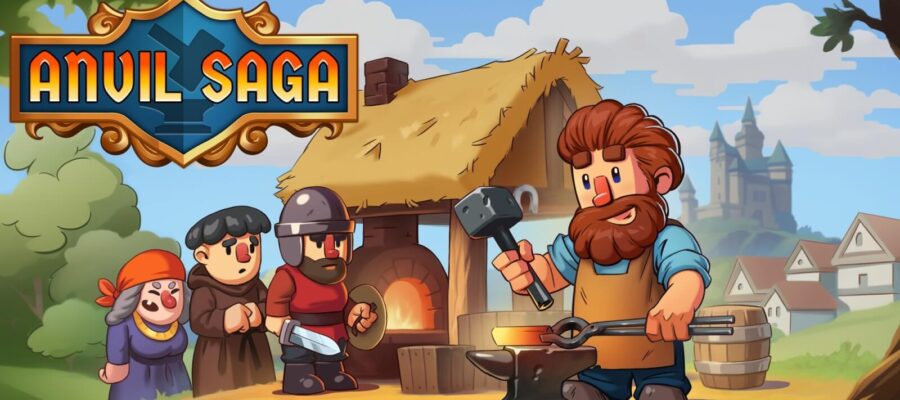
Game: Anvil Saga
Genre: Simulation, RPG
System: Nintendo Switch/Switch 2 (Also on Steam (Windows), Xbox One/X/S)
Developer | Publisher: Pirozhok | Herocraft
Age Rating: US 10+ | EU 3
Price: US $19.99 | UK £17.99 | EU € 19,99
Release Date: June 26th, 2025
A review code was used, with many thanks to Herocraft.
James gave his thoughts on the early access version of Anvil Saga back in July 2022. It was fully released on Steam in November 2023, and now it’s the turn for some of the consoles.
Will I be hammering to victory, or will I get my fingers burned?
Kindling the Fire in Anvil Saga
There are two game modes, Story (sometimes referred to as Campaign) or Sandbox. Both game modes have difficulty: Storyteller (easy) for those wanting to follow the plot, and Master Smith (hard) for those not put off by difficult choices and who want to earn less gold for their work!
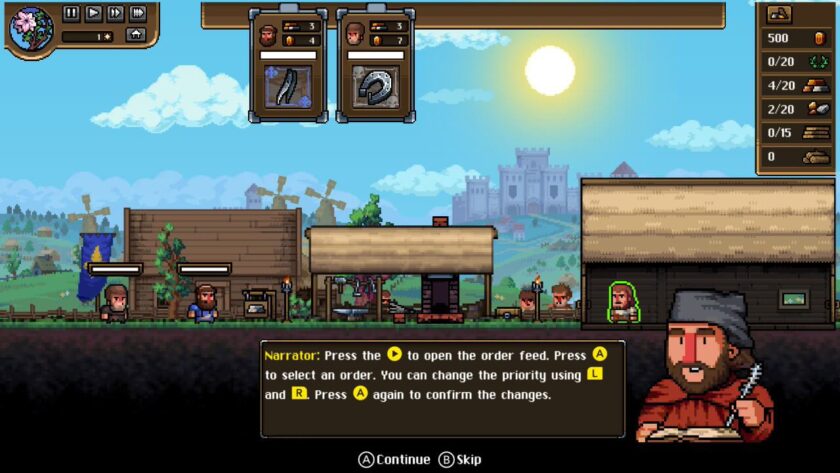
As Anvil Saga tells us, being a blacksmith is not easy, so both modes give the option of a tutorial. This introduces the basic commands and teaches you how to cast and forge, how to buy from the merchant, and how to build extra rooms, together with furnishing them. There is no time pressure; however, it does not form part of the main game.
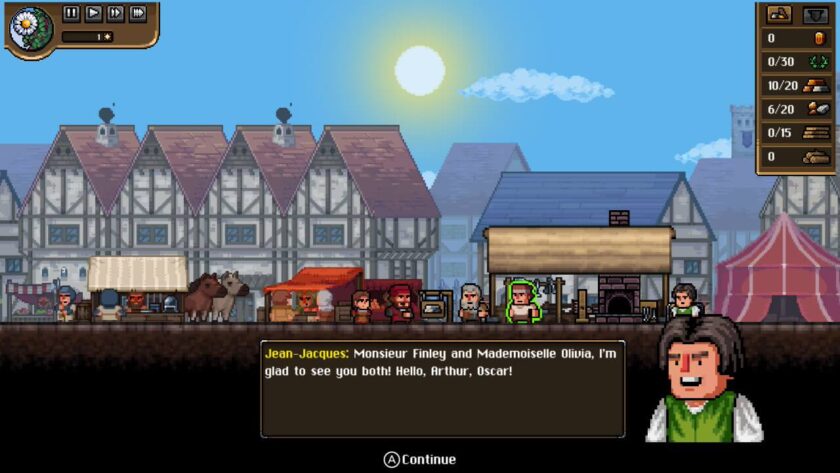
If you’re playing the story mode, there is a small interactive section that introduces you to some of the characters you will meet throughout the story and some choices that will affect your future. If you’re playing in sandbox mode, you’ll go straight to the forge and start working.
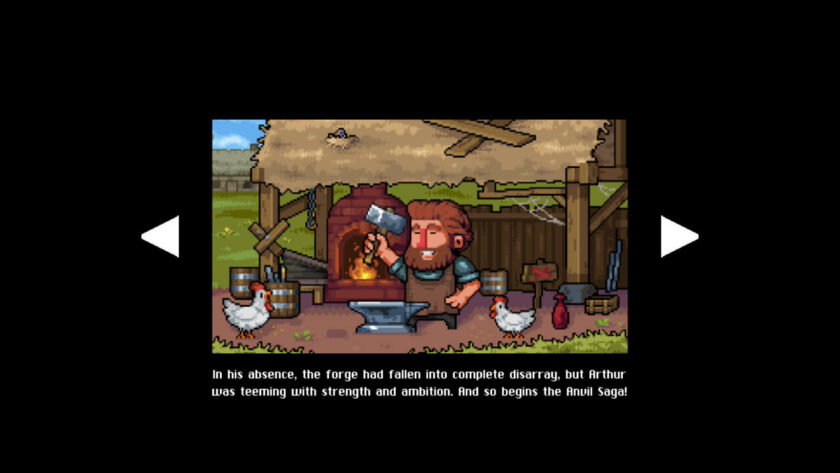
You play as Arthur, son of the late Oscar, who was a highly regarded master blacksmith, born in England, but who made his life in France and was well-known within Gascony. Anvil Saga is set during the time of the Hundred Years’ War, a conflict between England and France, during which time Gascony changed hands several times.
Forging your way in Anvil Saga
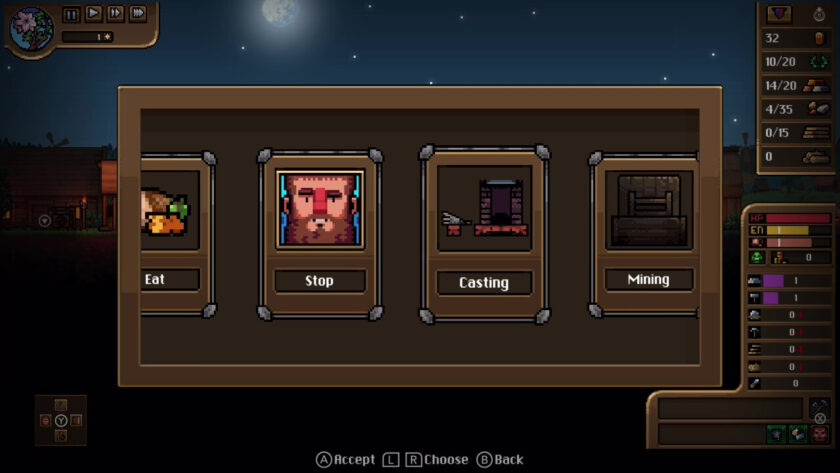
Each of your Anvil Saga workers (including Arthur) will need to sleep and eat to maintain their health and skills. Their energy and hunger levels are shown on screen, along with lots of other information about skill levels and stockpiles. You can access each worker individually and control what task you want them to do. In Story mode, you will very quickly be guided to hire an apprentice, as well as build a mine. The more workers you have, the more wages you will need to pay out, but you will be able to take on more quests as you can send your apprentices out on missions.
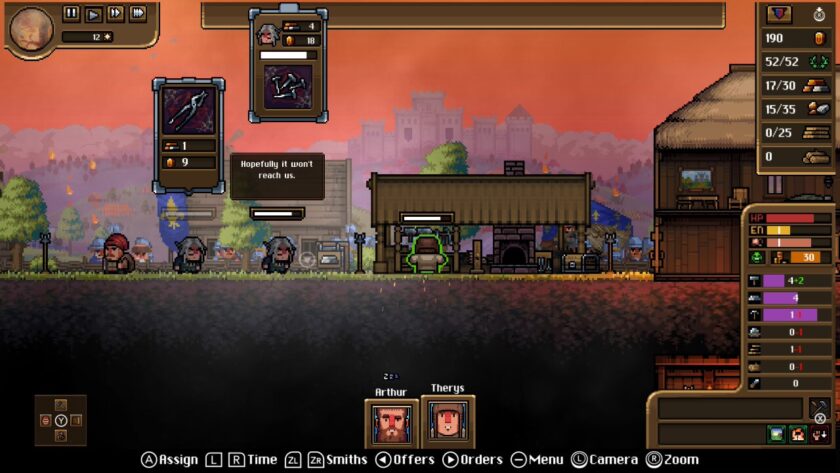
However, the core business of Anvil Saga is mining for ore, casting into ingots, opening your stall and forging the required items. Whether it’s nails or a sword, Arthur and his team will be able to forge it. You will have a constant stream of customers, and building on the setting of the Hundred Years War, you’ll have to decide which fraction to support: the English or the French.
In addition, you’ll have bandits to placate, as well as balancing the rival actions of the monks and witches. Upset any of the factions, and you’ll end up paying some penalty, for example, having furniture stolen by bandits, or being unable to sleep as the monks ring the bells through the night.
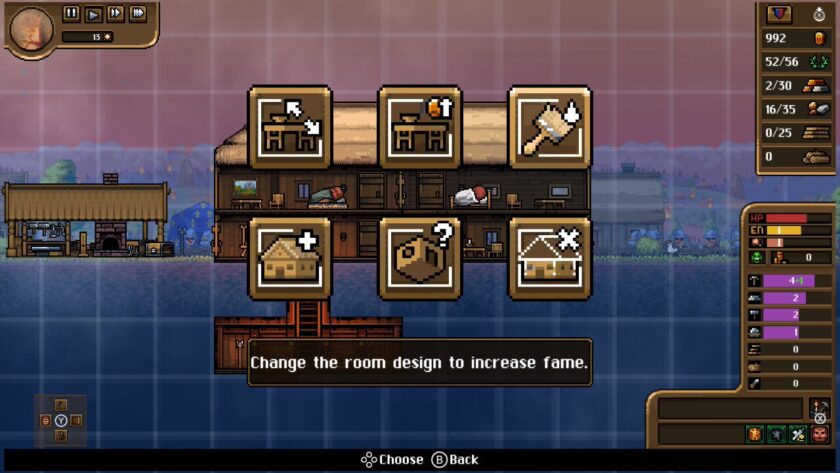
As with any business, you’ll be able to use the gold to increase the size of your house, as well as upgrade the materials used in the building. Improving your walls, floors, and doors will increase your prestige (also referred to as fame), and this will mean more money for your crafted items and the ability to upgrade the stall, so you can offer other services, like blade sharpening, and wood carving.
Hammering your own Anvil Saga
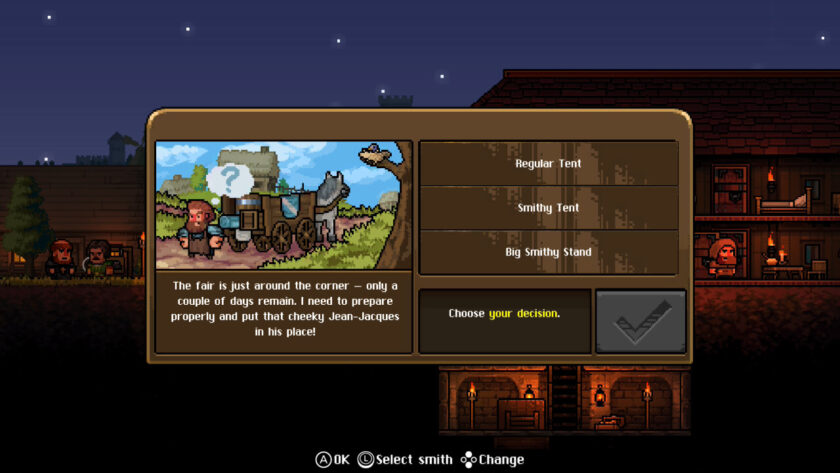
Not only do you have to decide which fraction to support, you also get other choices throughout Anvil Saga, which drive the outcome of the gameplay. Decisions like the kind of stall to have at the fair, and whether to help a witch on the run. This, along with environmental issues (like forest fires or heavy rain) affecting the number and types of customers, makes each playthrough of Anvil Saga quite different.
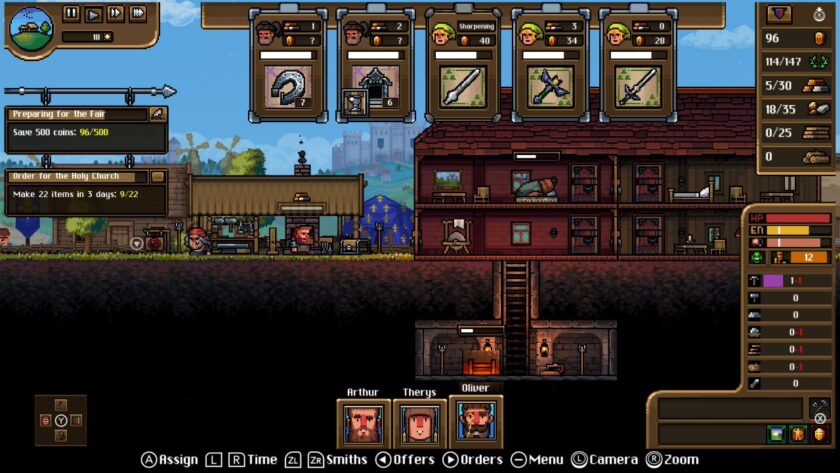
Within Anvil Saga, there is certainly a lot going on; however, at times, you are required to complete tasks which you don’t have the skills for. Although my forge was equipped with a grindstone, I couldn’t sharpen all the blades, but it was unclear what I needed to do to be able to complete those requests. Luckily, as this was just a normal customer, I could reject their request. However, there were times when I couldn’t reject the order, and I was left waiting for it to expire, with no knowledge of what was needed for the future. I eventually learnt that I needed a library, so my workers could study additional skills.
Gameplay
Some of the actions are slightly unintuitive, for example, using + to buy or L/R to move furniture but all of the controls are on screen to remind you, if somewhat small on a handheld device. The graphics, although very cute in their pixel form, were dark and certainly difficult to make out with any glare on the screen. Occasionally, I struggled to see which option I was selecting, especially in the merchant or build menus, and had to go back and forth to make sure I was doing the action I wanted.
There is some confusing naming within Anvil Saga: Is it story mode or campaign mode? Is it fame or prestige? And when tasked with placing a grindstone, the very expensive one I bought from the merchant was not the correct item; instead, it was a piece of furniture, both of which referenced sharpening blades, so how was I meant to know the difference?
The game autosaves, so luckily, when Anvil Saga crashed as I took on Finley’s request, I didn’t lose much progress. You can save or exit at any point, and with four save slots, you can have multiple games on the go.
The music is very pleasant, and its medieval tunes work really well for the setting.
As per the North American age rating guidance, there is some mild language and violent references, which might upset younger gamers. However, there is some good humour in it, with references to Batman, Link, and others.
You can speed up the day, which is great when you are waiting for your workers to finish their sleep. Generally, an Anvil Saga day/night cycle takes about 10 real-time minutes, but the game pauses when you access the menus.
Conclusion
There are lots of positives to Anvil Saga, and with the different fractions and choices within the game, there is plenty of replay value. There has obviously been a lot of thought and dedication put into the game, but with some confusing references and dark graphics, it didn’t quite craft a cast iron impression on me.
Final Verdict: I Like it 
Do you like our content?
Support LadiesGamers as a member on Patreon!
 Or buy us a cup of coffee or tea on Ko-Fi!
