

Game: Heaven’s Vault
Genre: Adventure, Puzzle
System: Nintendo Switch (also on PC, PlayStation 4)
Developer | Publisher: inkle
Age Rating: US T | EU 7+
Price: US $17.99 | UK £14.99 | EU €15,99
Release Date: January 28, 2021
Review code used with many thanks to inkle!
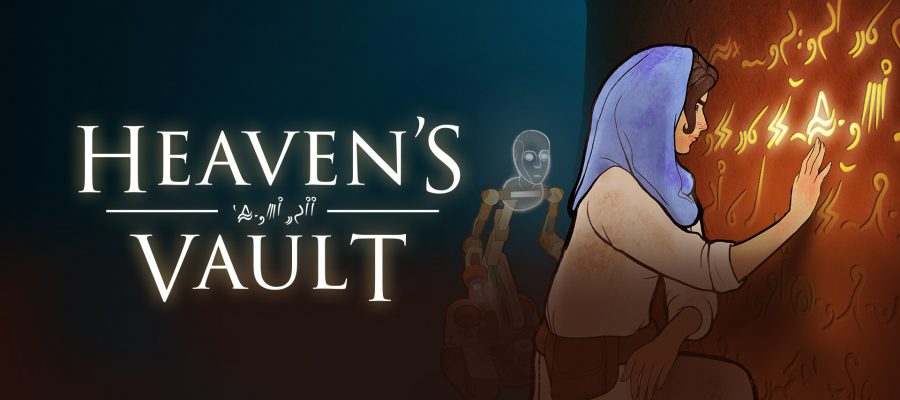
Heaven’s Vault is an odd game to write about because there’s a lot of things about the game that I feel I can’t rightly discuss in a review. It’s the sort of game where it really is best to go in knowing as little as possible for maximum enjoyment… buuuuut I can’t very well just write “it’s good” and call it a day. So: Heaven’s Vault is an adventure game with a heavy emphasis on story and a unique gameplay concept focused around translating an ancient, long-dead language.
Players assume the role of Aliya, an archaeological historian tasked by her mentor with finding a missing roboticist and assigned a robot companion named Six to help her on her mission. The setting is “The Nebula,” which is a series of inhabited moons connected by space rivers and which are gorgeously rendered through a combination of 3D models and hand-drawn art.

Mysteries on Mysteries
That was information you get in the first fifteen to twenty minutes of the game, there is of course much more to it. Gaining a deeper understanding of the setting and story comprises much of the joy of the game, though not all of it.
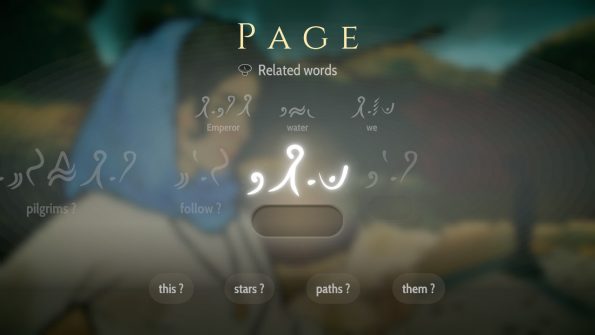
When starting out Aliya (and by extension the player) has a very sparse dictionary for Ancient script, meaning that translation puzzles must be solved mostly through context clues or flat-out guessing. In fact, even into the mid- and late-game there are many times when the player cannot be sure they’ve solved a puzzle properly until later, which I found to be an excellent way to encourage continued play. The feeling of satisfaction when you realize you got a translation right is incredible, and the fact that said feeling is delayed is just as effective at keeping the player invested as the intrigue of the actual story is. Even better, this unique gameplay structure means you’ll never hit a wall the way you would in other adventure games. There’s never a point where you’re simply out of luck because you can’t figure out what the moldy cheese wheel or bent fork that have been sitting in your inventory for half the game are used for.
Tension and Relief
Speaking of progression, the way the story unfolds is a masterwork in pacing. Though I can’t get into specifics (yes, still) I will say that Heaven’s Vault has some of the best marriage between gameplay and narrative I’ve ever seen. Because as the pool of translations you have to draw from grows in scope and complexity, so too does your understanding of The Nebula’s historical and current circumstances. In turn, that deepening understanding leads to a mounting sense of dread about what might be at the end of the road Aliya is investigating, but not one that ever becomes too much to handle. In part this is due to the fact that, despite all the different tensions at play, there is an odd sense of serenity to it, especially when sailing the aforementioned space rivers. At the risk of saying a bit too much, I found this helped me to get into Aliya’s head a bit better; she doesn’t particularly like spending time around other people, and when I had the time spent sailing between locations to myself, away from all the problems of The Nebula for a bit, I really got why. Put in another, shorter way: all the different aspects of characterization and atmosphere in Heaven’s Vault work together phenomenally to enhance and elevate one another.

Not Quite Perfect
There are some criticisms I have of Heaven’s Vault, minor though they may be. Firstly, when initially starting the game it can be a lot to take in. The first time I started playing I immediately felt lost and overwhelmed, and ultimately I had to stop playing before restarting the whole game when I came back to it later. I will admit that I was already feeling stressed and frazzled that day, which almost certainly contributed to this feeling, but on the other hand I like to play games to relax (as many people do) so make of that what you will. Secondly, and actually more frustrating in the long term, I thought the menus were a bit of a pain to navigate. The player has access to a map of The Nebula as well as a timeline for keeping track of both historic and modern events relevant to Aliya’s journey, and it is not always easy to select the thing you want to in either of them. I’m unsure if this is a factor of the switch’s interface or a deeper design issue, but given that this is a review of the switch version of the game it doesn’t really make a difference.
Conclusion
Quibbles aside, I did greatly enjoy Heaven’s Vault. All of its major design choices are artistically brilliant without sacrificing the more visceral thrills of its gameplay, something which many other “games as art” titles have an unfortunate tendency to do.
It’s a bit on the longer side – especially if you play through it twice, which is encouraged by the developers – but it’s well worth it, especially if you play it cuddled up on the couch during what remains of winter.
Final Verdict: I Like It A Lot
