



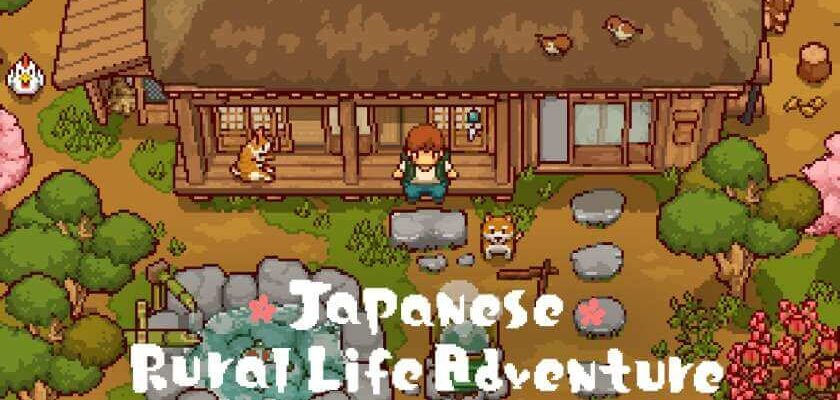
Game: Japanese Rural Life Adventure
Genre: Simulation
System: Nintendo Switch (Also on Steam (Windows) and Apple Arcade)
Developer | Publisher: GAME START LLC | G-MODE
Age Rating: US Everyone | EU 3+
Price: US $24.99 | UK £22.09 | EU € 24,50
Release Date: March 5th, 2026
Review code used, with many thanks to G-MODE.
Originally released on Apple Arcade, Japanese Rural Life Adventure takes a pixelated view of traditional life in the Japanese countryside.
Will this be the perfect escape to the country?
Let’s Go on a Japanese Rural Life Adventure!
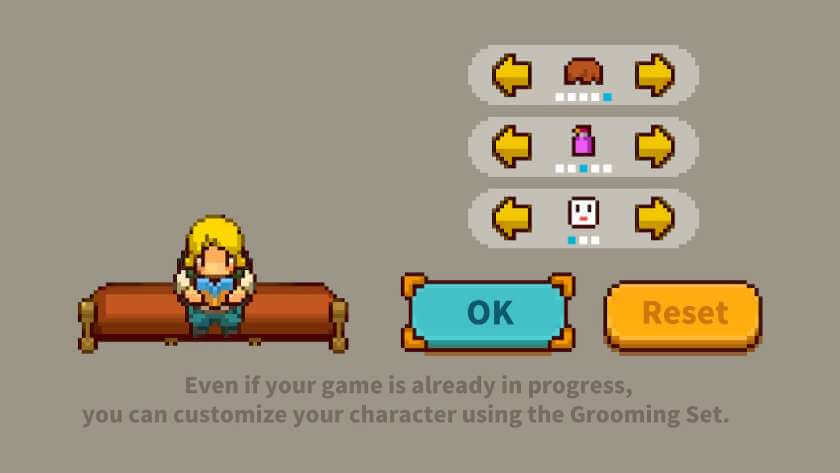
Before you can start your adventure, you need to create your character. If character customisation is really important to you, then Japanese Rural Life Adventure is not going to impress. There are just 5 hairstyles, with 5 colours, and 3 skin tones to choose from, but at least you can swap between this limited selection from within the game using grooming kits.
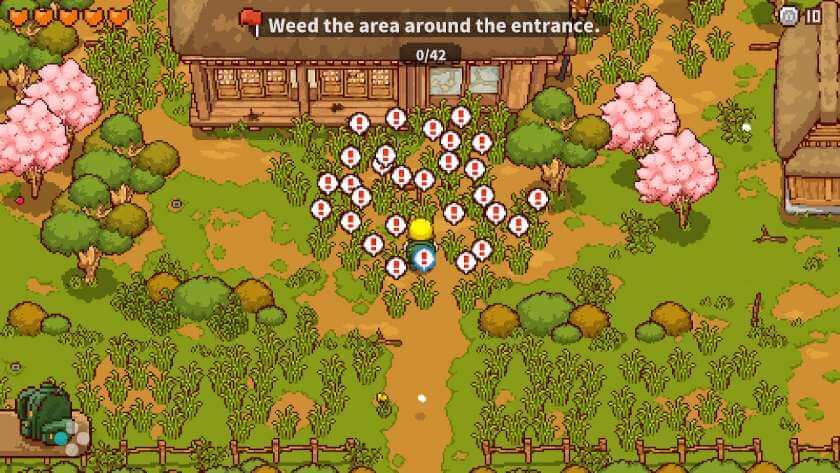
You’ve decided to leave the city and move to a small, somewhat derelict village in the countryside. Arriving by train, you find the front of your rented property in an untidy state, so your first task is to clear the weeds. Although there are 42 to pick, it doesn’t take long to do, as you collect several weeds for each press of the button, but it does cost half a heart of energy. On entering the house, you find lots of trash, and the sleeping area needs cleaning. Obviously, you didn’t come equipped with a vacuum or power washer (after all, there is no electricity), but you did bring your guidebook to Japanese country living.
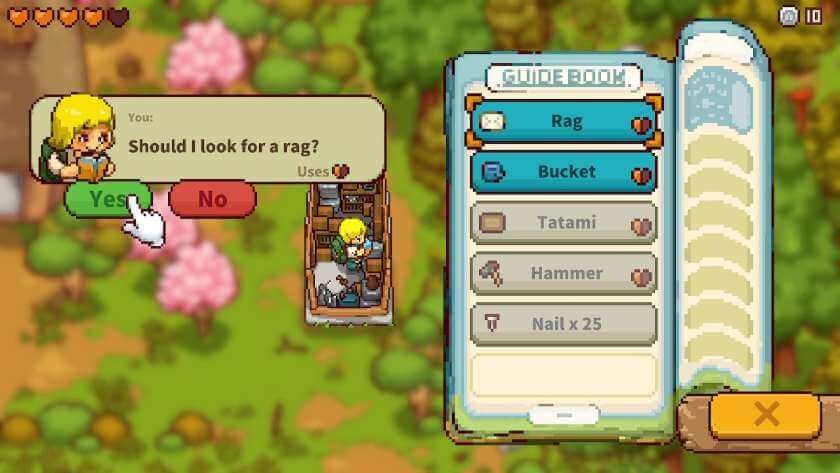
The guidebook explains every process you will need to enjoy your Japanese Rural Life Adventure. Need to know how to clean the floors? According to the guidebook, you’ll need a rag and a bucket of water. Where to find such equipment? The guidebook points to the shed. Following the prompts, you remove the rubbish, clean the tatami room, and replace the mat. Then, having run out of energy, you have a quick nap. Not long after, the landlord arrives and demands that you clean and repair the house in order to stay.
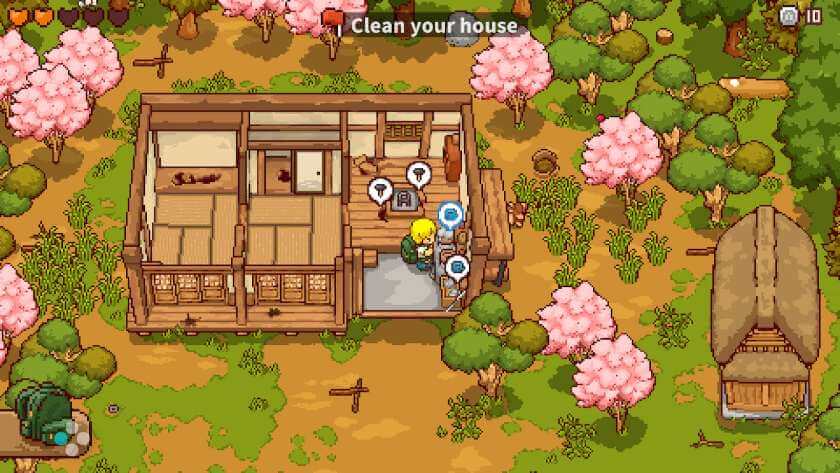
As you approach the different areas in the house, action icons will appear. The guidebook will open as you interact with the icons, giving details as to the equipment and resources needed. Once you have all the necessary items, you’ll complete the task. If you’ve already completed a similar task, then you’ll just do the work; the book won’t appear again for that task unless you are short of resources. The whole ‘play as you learn’ start to Japanese Rural Life Adventure is well guided and introduces the main activities. Anything new going forward will be explained, and you’ve got your guide to Japanese country living if you need more help.
Once you have cleaned and repaired the house, you’ll receive an extra energy heart, the calendar and clock will appear, and you’ll be prompted to enjoy the countryside life however you like.
Planning Your Japanese Rural Life Adventure
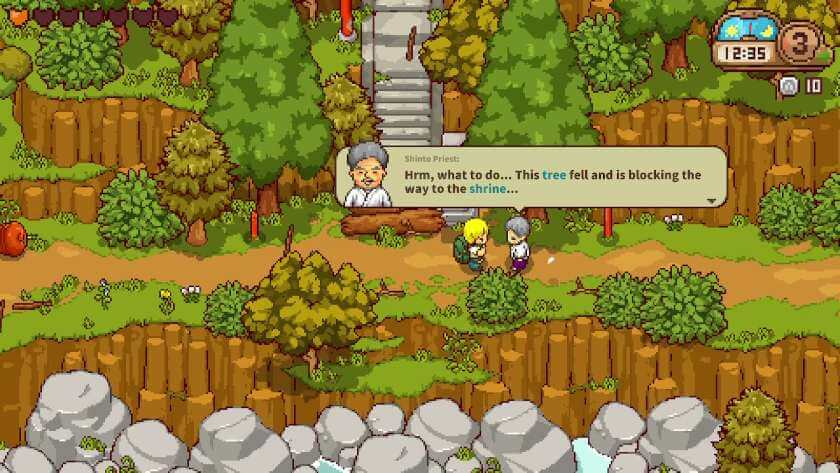
As you wander around your immediate area, you discover just how rundown the house and village are. New paths need to be created, fields need to be tilled, a well needs to be dug, and a chicken coop needs to be built. The travelling saleswoman won’t sell anything until she can sit down on a bench. The post box has collapsed, and the Shinto temple is blocked by a fallen tree. Of course, it’s up to you to collect the resources, build and repair what you can, or pay for additional services beyond your skills.
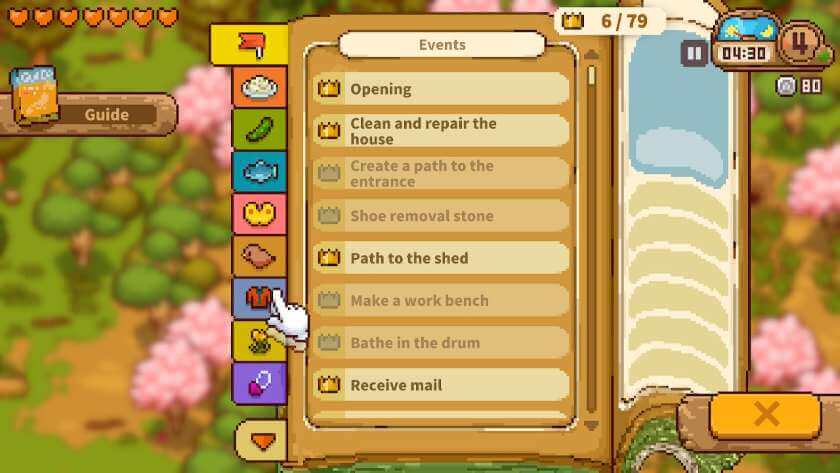
However, you’ll have to prove yourself before gaining access to some of the other areas. This is done by completing events, either a set number or a specific group. The guidebook lists all the possible events. For example, to remove the fallen tree, you need to complete 10 events (and pay for the professionals); to open up the path to the main village, you need to clean the shrine, make a shishiodoshi (water feature), and build a coop.
I really enjoyed this approach to tasks in my Japanese Rural Life Adventure. You are guided as to what to do, but given freedom as to when you do it.
Some tasks can’t be completed immediately, and others require lots of energy or resources. Resources, like flowers, rocks and wood, appear regularly throughout the day, but you are limited to 99 per item in your backpack. Other resources, like string or candles, need to be bought. You can sell items to make money, but there is no shipping bin in Japanese Rural Life Adventure. You sell specific combinations of items, like 10 branches together with 5 berries and 3 small logs, to the Guy from the Village Office, who drives to your house every afternoon. You’ll also get paid for completing some of the renovation work around the village.
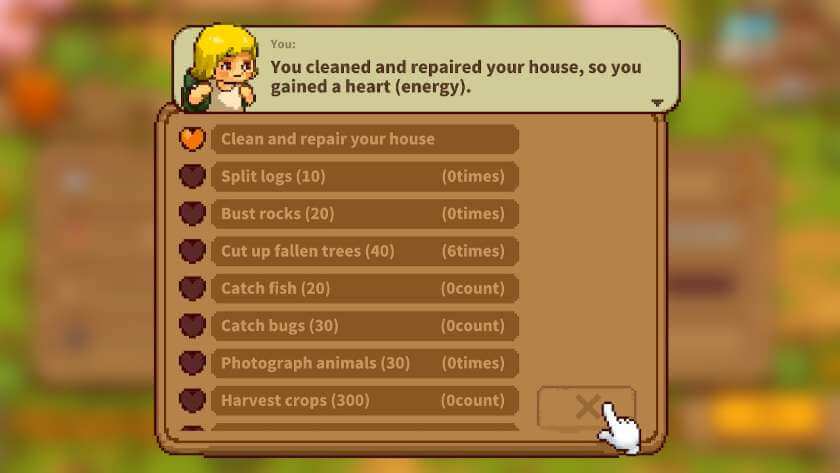
You start with 5 energy hearts (6 once you’ve cleaned the house), and this will increase as you attain certain targets. Some activities, like fishing and building, will use energy, whereas other activities, like collecting resources, harvesting or watering, don’t. Once you run out of energy, you can return to the house for a nap. A nap takes an in-game hour and restores all your hearts. Alternatively, you can eat food, but you’ll need a picnic blanket to do so, unless you eat by the hearth in your house.
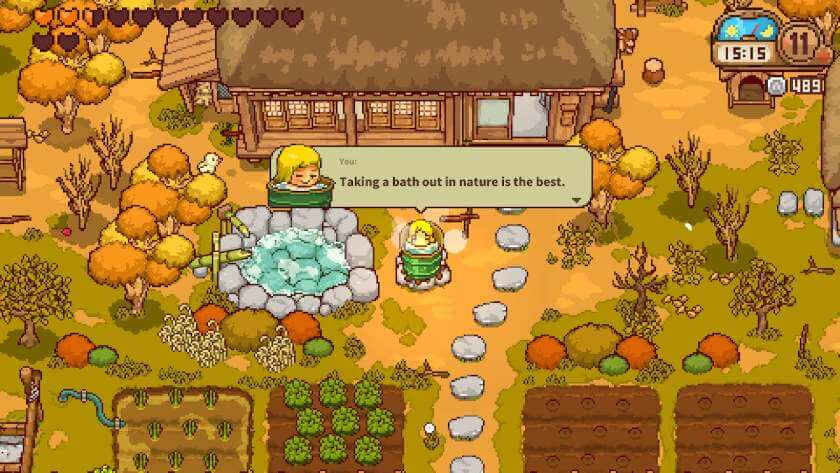
Of course, all the hard work takes its toll, and soon your character and clothes get caked in mud. In this condition, nobody will talk to you, but you can fill the large drum with water, light a fire underneath and take a well-deserved (and necessary) soak. I love this addition in Japanese Rural Life Adventure; managing your hygiene levels adds another layer to the game.
Japanese Rural Life Adventure Activities
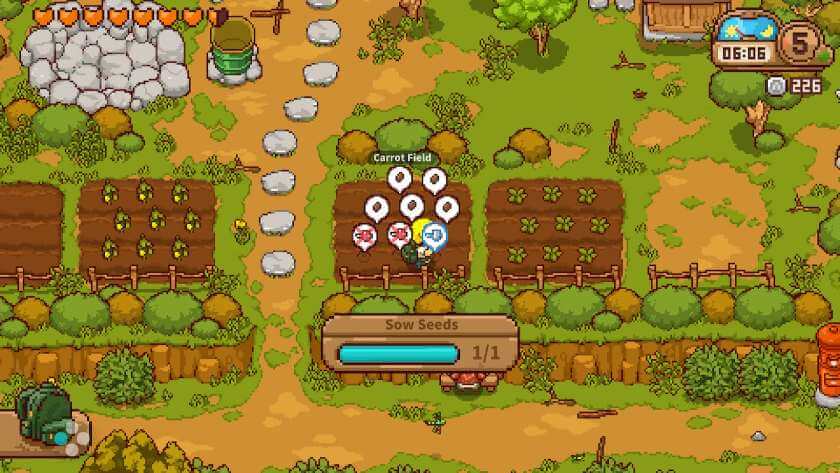
Unlike other farming or life sims, you don’t have free rein to build or grow where you want to in Japanese Rural Life Adventure. The well, doghouse, chicken coop and so on, must be built at the designated spot. There are 3 fields (each containing 9 of the same crop) and a rice paddy, as well as places for 4 fruit trees. Initially, it felt restrictive, but there are other benefits. There is no seasonal harvesting; crops and fruit trees grow all year long, and all crops take just four days to grow. You can buy crops and trees from the travelling saleswoman at a reasonable price, and the crops come pre-bundled in 9s.
Fishing, catching bugs and splitting logs are done via a mini-game, and although it uses energy, it is more a game of chance than skill. Certain tasks, like growing a bonsai or gaining your animals’ trust, will increase your luck, which in turn, increases the chance of finding rare fish, critters or wildlife to catch or photograph. Cooking is a guided process of chopping, steaming and mixing, more akin to cooking simulations than farming ones.
Once you’ve built it, there is a museum to fill with treasures (if you can find the hidden treasure chests), and in addition to making clothes, you can create pots in your own kiln. Gaining the trust of your cat and dog takes food, starting with simple berries, progressing to sliced vegetables and ending with tamagoyaki (omelet). As well as your own pets, there are 27 other cats to befriend, so the villagers can continue to look after them.
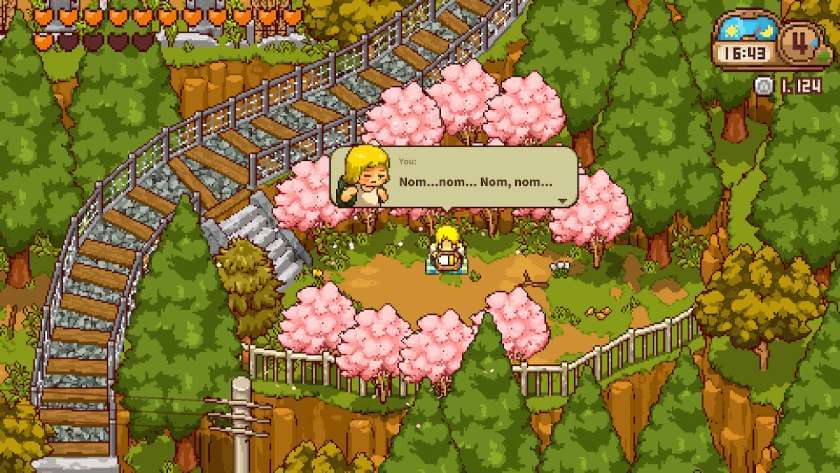
Participating in the many traditional Japanese festivals and gifting specific items helps build friendships with the locals, and eventually you’ll be rewarded with a gift. Repairing the village infrastructure and attractions bring tourists back to the village, making it feel more vibrant and active. An important aspect of Japanese Rural Life Adventure is to enjoy the cultural heritage. You need to take time out to enjoy the cherry blossom, help craft lanterns for the summer festival, and send New Year greetings.
Gameplay
The controls are easy to understand, with interaction points appearing on screen. Japanese Rural Life Adventure plays well in both docked and handheld mode, with the text large enough to be read on the Switch Lite. As the game was originally developed and released via Apple Arcade, there is full touchscreen functionality.
There were a couple of frame rate issues on the docked Switch, but nothing which detracted from the gameplay.
Japanese Rural Life Adventure autosaves frequently, and there are 3 save slots.
An in-game day generally takes 20-30 real-world minutes, but it’s dependent on the number naps, and at what time you go to sleep. In-game time is paused when you are studying your guidebook.
Conclusion
Japanese Rural Life Adventure is more about restoring a community than farming and fishing. The limited character customisation options are more than made up for by the wide range of activities. The progression through the game is well-balanced, and there is satisfaction in completing the various events.
However, where Japanese Rural Life Adventure really shines is its ability to immerse the player in the rich cultural heritage of Japan. The game encourages you to learn about the many festivals and traditions, demonstrates the patience needed to prepare some of the culinary delights, and teaches the importance of slowing down to enjoy your surroundings.
Final Verdict: Two Thumbs Up 
Do you like our content?
Subscribe to our daily news and never miss a review!