


Game: Voxelgram
Genre: Other, Strategy, Puzzle
System: Nintendo Switch (also on Steam)
Developer | Publisher: Procedural Level | Lukasz Krasniewski
Age Rating: EU 3+ | US E (Everyone)
Price: US $7.99 | CA $9.99 | AU $ 9.99|£ 5.79 | € 6,59
Release Date: 27th February 2020
Review code used with thanks to Procedural Level
A good concept, but it fell short of my expectations.
Gameplay
Everyone knows I love a good Picross-style game. They’re simple to learn but hard to master, and very easy to lose a few hours to in a single sitting. Voxelgram takes the classic Picross formula and gives it a lively new 3D take; each puzzle has multiple layers, so you now have three sets of ‘grids’ to think about when placing or removing squares.
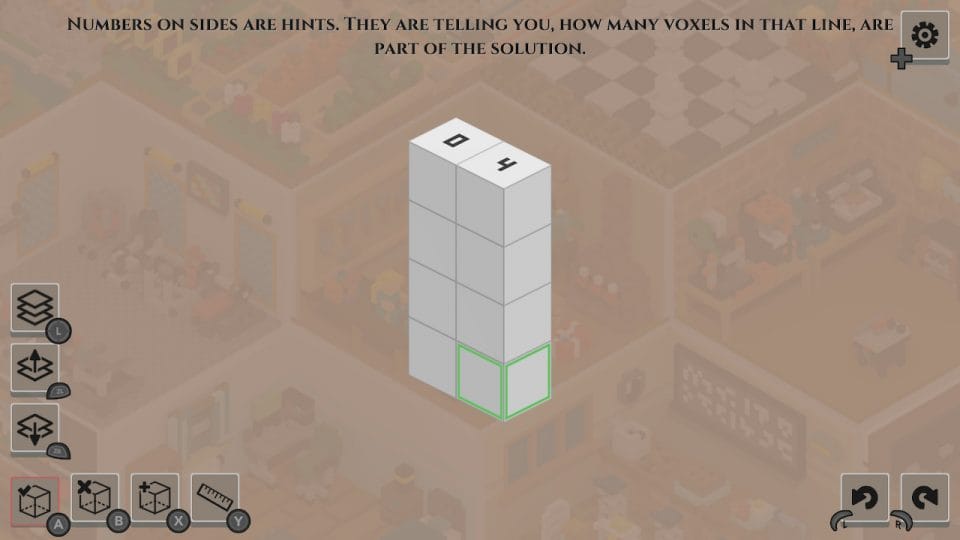
The controls are nice and easy; A to place, B to delete, X to mark blank, LT to move forwards a layer, RT to move backwards a layer, L to undo, R to redo, and left stick/D-pad to move. The navigation between the layers gets very confusing very quickly, and I often found myself flicking back and forth trying to find the level I wanted. Unfortunately, there are some blocks that have no numbers assigned in any direction leaving them as complete guesses, which as a Picross fan I found very annoying – I don’t like having to just guess at blocks, I like to logic it out properly.
One other thing that was just annoying was that when you finish a level you’re backed right out of that diorama, so you have to navigate back down 1-2 levels and scroll right across the list again to do the next puzzle. Honestly, that just felt clunky and inconvenient – it’d be far better if, on finishing a puzzle, you stayed highlighted on that one to navigate from rather than being sent back to the upper menu. It’s not a problem exactly, but it made doing multiple puzzles back-to-back a bit of a drag.
Graphics and Sound

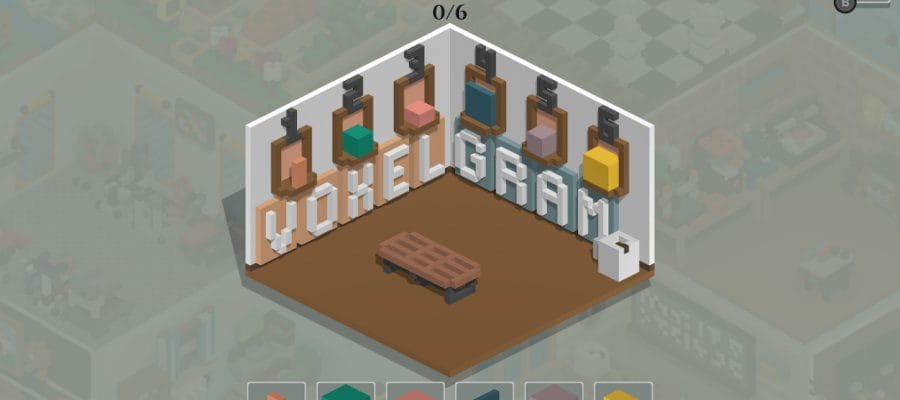
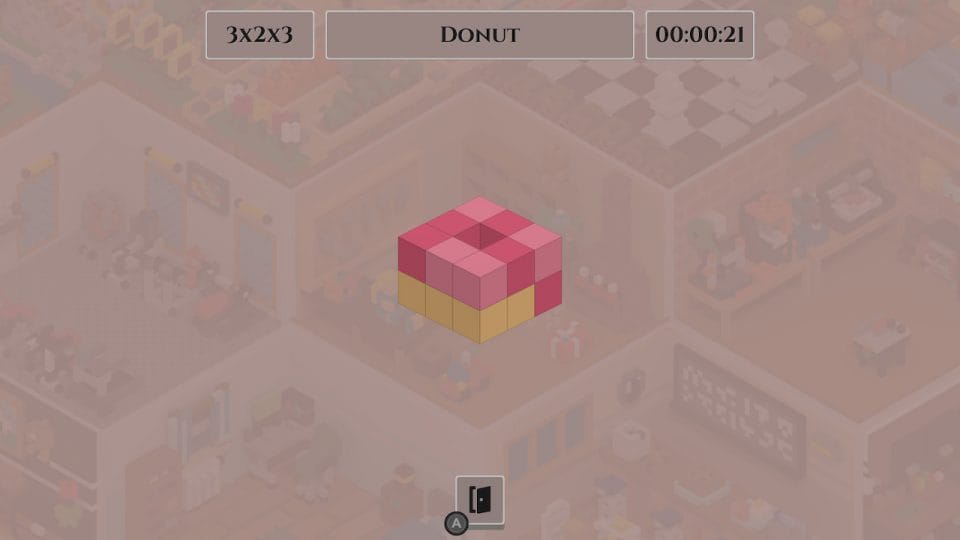
I can’t fault the graphics. They stay nice and simple, which is necessary for a game that makes you think as hard as Voxelgram does. The blocky, pastel aesthetic really works in this game’s favour and makes the dioramas cute to look at. The graphics during the puzzles themselves are as good as they could be too; the different levels of the view are marked by a grid along the bottom to help you track where you are, though I found it hard to keep in view when moving my perspective around and often ended up lost. Simplicity is the name of the game with Picross puzzle graphics, and these were definitely simple in a good way.
The sound was cute. It wasn’t exactly relaxing or stimulating, or anything specific, it was just there in the background and largely ignored because it didn’t stand out at all. It’s a shame because some perky music would have upped this game in my opinion.
Difficulty
This game is hard. Like, I started struggling on the tutorial levels hard. It feels like Voxelgram is supposed to be Picross but harder, but went too far and ended up in just frustratingly difficult. I didn’t feel accomplished on completing a level, just a resignation of “oh it’s done, now I have to do another one” rather than the “ooh I finished and enjoyed that one, I want to do another” that is really the bread and butter of games like this.
I understand what was intended with the 3D grid, but it just didn’t work very well for me. It was too hard to navigate, and some blocks didn’t have any numbers assigned which made completing them a matter of guesswork which I really didn’t like. Also against the traditional Picross mechanics is that there’s no assignation of spacing. For example, on a traditional Picross, you’d have 1 1 1 indicating that there are three filled squares, each with at least one space in-between. Conversely in Voxelgram, it’d be 3 2 to indicate three filled squares and 2 blank squares somewhere in the middle, which makes puzzling out the solution really difficult because it could be 2 blocks/2 blanks/1 block, 1 block/1 blank/1 block/1 blank/1 block, or 1 block/2 blanks/2 blocks.
Conclusion
I went into this wanting to like it. Unfortunately, while the graphics are nice, the game is just too difficult and navigationally awkward to enjoy for me.
I think with a couple of navigation tweaks and more complete numbering this would be a very fun and challenging puzzler, but for me it was bit too frustrating.
Final Verdict: I’m not sure 