


An early access code was provided, and many thanks to Rice Games.
Shujinkou and the Battle For Language
There have been several popular video games over the years that have built on improving our literacy. Typing of the Dead is the weirdest platonic ideal of this concept, but what’s much harder to do is create fun, engaging games that don’t just help us practice our own linguistics but assist in learning other languages. Mostly, what dedicated language students do is try to get some basics down in the new language of their choice and then load up something like Pokemon in that language —usually Japanese — to practice.
To actually have a game help you learn the language is always a surprisingly lofty goal. There’s a handful of games that turn learning kanji or hiragana into games, but they never really seem to stick. Enter Shujinkou, a passion project by Rice Games. It’s an Etrian Odyssey-style dungeon crawler with a twist. Learning bits of Japanese and collecting magical bits of elementally-coded root words will help your team defeat the akuma, demons assaulting your once-bucolic countryside. How does it all work? Quite well, actually!
Accessibility Matters in Shujinkou
The first thing to note is that if you’re simply desperate for another grid-style dungeon crawler (that’s the format the Etrian games are in, along with its biggest ancestor, Wizardry), you can absolutely play Shujinkou as a straight English game if you really want. But it’s vastly more fun to tweak the options presented to you as the game starts and give yourself an opportunity to learn some basics along the way.
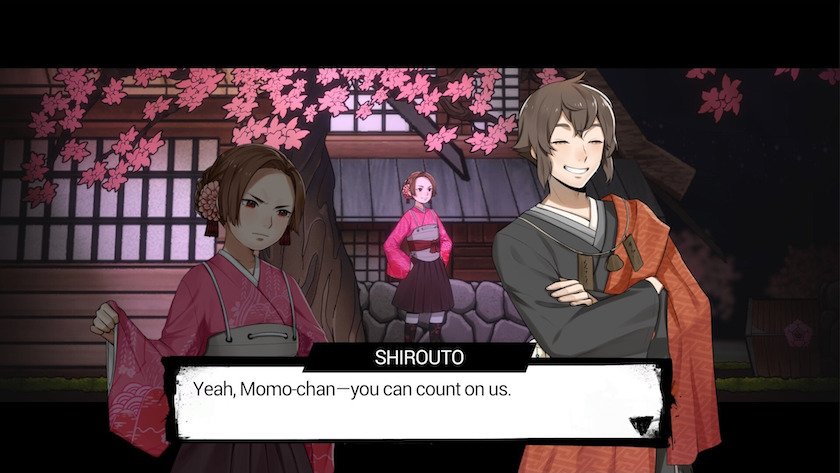
Even the game’s name is a gag based on the language, one with layers. It took a while for me to realize it, but shujinkou literally means main protagonist. You’ll quickly be introduced to your first party member, Shu, who’s a young but wearily retired samurai pressed back into action as the demons attack the town. So, yeah, your hero protagonist is named Hero Protagonist, and now you know your first Japanese pun. Eventually, you’ll meet others who are tied to your fate, and you’ll never guess what their names are.
You’ll also fall in love with little sister Momoko, who loves peaches. And now you know what a peach is if you ever want one in Tokyo. Everything is like that: little rounds of descriptions that go back to teaching you the meanings of things. As you go along, a glossary is filled that you can refer to anytime, until you realize you really do understand what the kanji for ‘tea’ looks like, and can start to infer the flavor based on what other kanji accompany it.
Combat With Words
The dungeons, which are some pretty hefty gaming meat in between some long but not draggy visual novel sections, are instantly familiar to anyone who’s at least tried a grid-style crawler or even a basic turn-based JRPG. This frees you up to pay attention to the language-based wrinkles you get to play with, from the elemental kanakae orbs (which still befuddle me a bit, but I’m getting there) to skill trees. It’s all introduced gradually enough that it’s easy to avoid being overwhelmed.
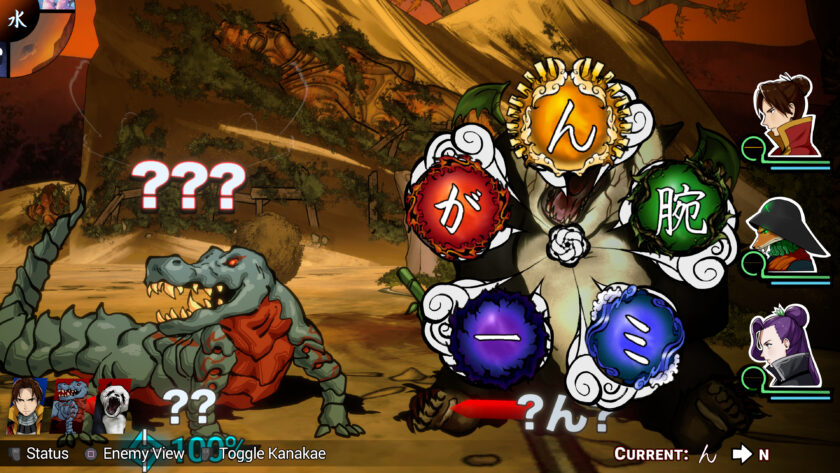
The combat itself is nicely strategic; you’re going to help yourself a LOT as you do figure out the systems in play. Not doing so simply makes everything tougher on you, so every little bit you learn helps. Not that it’s ever frustrating, again, the game is pretty well-balanced and escalates at a reasonable pace.
There’s a lot to Explore in Shujinkou
The game boasts about 80 hours of play and states it’s the first of a trilogy. That’s a lot of gameplay for a dungeon crawler, although a dedicated fan of the old Elminage games and whatnot can easily break that hour limit. Mixed in with those hours, though, is a ton of stuff to do, from learning how to draw kanji to mini-games that teach you how to form a sentence and other grammatical little tidbits.
None of it is meant to make you feel overwhelmed, and it’s a very take-it-at-your-pace game. The story is very well told, and the characters are all distinct and have clear concepts behind them, making it much easier to commit that amount of time to them. That’s doing a lot for making a player want to stick with the game and learn things at their pace without feeling like there’s a giant green owl looming threateningly behind them.
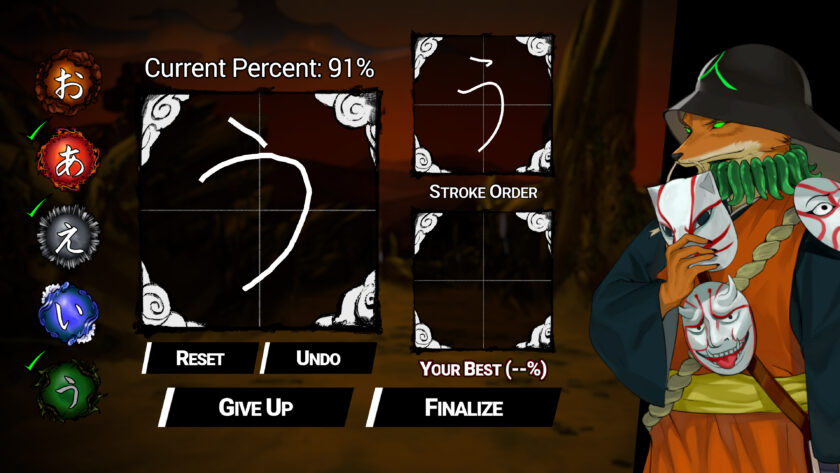
Even the art style is lovely, with the characters you meet featuring a very clean and upbeat anime style (without an excess of fan service). The monsters and the overall tone of the invasion are supposed to be inspired by the ukiyo-e style, which in this case is less about the clean woodblock lines of the art (which the monsters do have), but about the kinds of lives depicted by the style. It suggests some interesting things about the greater threat at play here, and I’m interested in seeing where that goes.
Final Thoughts
Shujinkou is an ambitious attempt to tackle what many games have tried to accomplish. It’s taking the Japanese language and making it something you enjoy learning in easy pieces and paced, apparently, along with the first three grades (5, 4, and 3, ascending upwards) of the JLPT, or the Japanese Language Proficiency Test, which non-native speakers are encouraged to excel at if they would like to be considered for work in Japan or immigrate.
That’s all pretty nuts and bolts to bear in mind, so for our purposes, know that it’s a game that is taking its attempt to teach you the language seriously without making life boring or slow for you. And it’s working, especially for JRPG fans who want to relax and maybe (even accidentally) learn a little along the way. It’s a game that’s never pushy or preachy about its goal, instead focused on basically telling you an intricate story while working flash cards quietly into its environments.
The passion of the team and the delight they feel working on this comes through. I was especially charmed by its opening memorial to their family. They’ve earned the right to feel proud about this, and it’s really shaped up to be quite a game. Whether you want to learn something or just want a soothing dungeon crawler, Shujinkou is one of this year’s first surprising achievements. Well done, team!
Do you like our content?
Support LadiesGamers as a member on Patreon!
 Or buy us a cup of coffee or tea on Ko-Fi!
